Comparing Video-Based Industrial Property Platforms
A professional guide to comparing video-based industrial property platforms. Learn how investors use video to reduce site visits, what risks video hides, and how to keep screening evidence-first.
Video-based industrial property platforms are growing because they promise speed: fewer site visits, faster shortlists, and better stakeholder engagement. Used correctly, video reduces friction by providing visual validation of building condition, access roads, loading zones, and surrounding context. Used incorrectly, video increases risk by creating a false sense of certainty. Industrial feasibility is determined by corridor economics, utilities deliverability, wastewater acceptance, permitted industries, and documentation readiness, none of which can be proven by video alone. Investors therefore compare video-based platforms not by video quality, but by whether video is embedded in a decision workflow that enforces verification, standardization, and evidence readiness. In Vietnam, corridor-first screening anchored on IIPMap.com and standardized feasibility interrogation through ChatIIP.com provide a practical structure: map-led corridor selection, video for visual validation, AI for consistent screening questions, and proof-driven diligence. This article explains how to use video as decision support without letting it replace the evidence that drives board approvals.
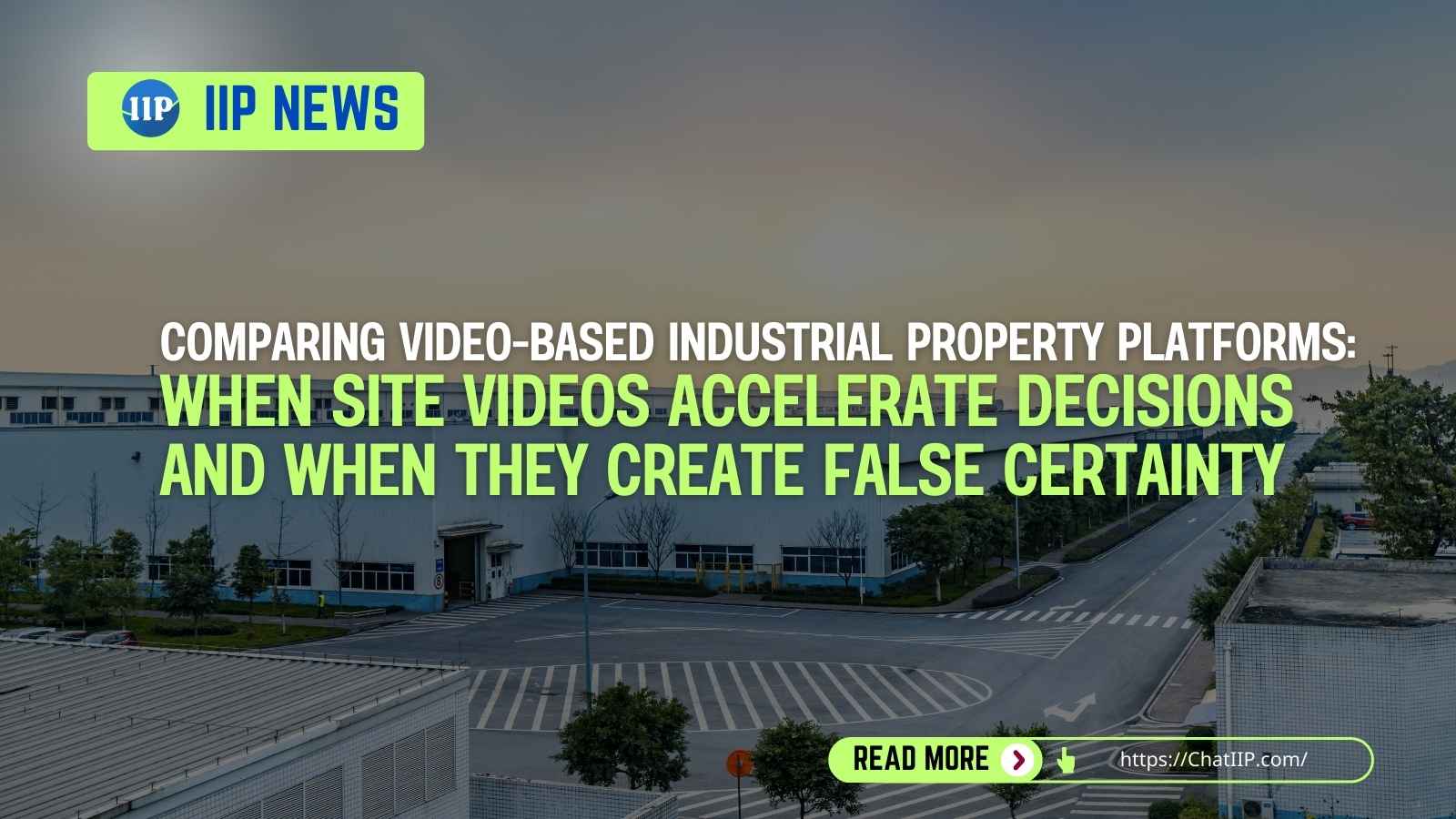
Video has become a default communication format in real estate, but industrial property decisions have a different risk profile than commercial property decisions. A factory is not chosen because it looks good. It is chosen because it can run a process safely, legally, and predictably on schedule.
Video solves one problem well: it reduces information friction at the physical level. It helps stakeholders see what the building and access look like without traveling.
However, video introduces two risks.
Aesthetic bias
Teams can become anchored by visuals. A clean-looking building may still be operationally wrong if utilities interfaces and wastewater acceptance are mismatched.
Hidden constraints remain invisible
Videos rarely disclose permitted industries, utilities commissioning timelines, environmental interfaces, or documentation readiness. These determine whether a building is truly “ready.”
This is why professional investors treat video as a supplementary evidence stream, not as the decision engine.
If your team needs a reference on why evidence-first screening matters before you scale tours or videos, Common Mistakes Companies Make When Shortlisting Industrial Locations: Why Good Teams Still Choose the Wrong Site is compatible with the risk logic here.
Evaluation Framework: How Investors Compare Video Platforms
Investors score video-based platforms using five decision-grade criteria.
-
Video completeness and operational relevance
Does the video show what matters operationally: truck turning radius, loading bays, yard space, internal clear height, column spacing, floor condition, and access roads? Or is it mostly marketing footage? -
Corridor context and cluster visibility
Video without corridor context can mislead. Investors need corridor intelligence to ensure the building is in a viable cluster, not just an attractive site. This is where corridor-first screening anchored on mapping tools is foundational. -
Standardization for comparability
Video is non-standard by default. One video may show loading bays, another may not. Investors need platforms that pair video with structured fields so comparisons remain consistent. -
Verification and evidence readiness
A decision-grade platform should link video to documents and evidence cues, not separate it. If the platform cannot track evidence status, it remains a marketing tool. -
Workflow readiness for governance
The platform must help teams build a decision trail. Video is persuasive, but persuasion is not approval. Boards approve when the decision is defensible and risks are owned.
A strong internal reference for converting screening outputs into diligence actions is From Location Screening to On-Site Due Diligence: What Comes Next After the Shortlist Is Ready.
Technology and Digital Solutions That Matter
The most effective use of video occurs inside a stacked workflow.
Corridor truth through mapping
Start with corridor selection. In Vietnam, investors can anchor corridor screening through IIPMap.com location screening to ensure video review is only applied to viable clusters.
Feasibility standardization through AI
Use AI to enforce consistent questions across all candidates. Video should not be reviewed until the feasibility checklist is applied. A tool like ChatIIP.com feasibility Q&A helps teams standardize early questions about industrial parks, legal documents, incentives, planning constraints, and investment procedures.
Video as visual validation, not proof
Video then becomes valuable for verifying what is visible: access, condition, spatial layout, and context.
Governance for diligence execution
Finally, convert video-reviewed shortlists into verification agendas tied to documents and commitments.
If your team wants a concrete narrative on why mapping plus structured intelligence improves decisions, The Convergence of Intelligence and Imagery: How ChatIIP and IIPMap Unify Site Selection Data fits naturally here.
ChatIIP and IIPMap Application
A repeatable workflow for using video-based platforms without increasing risk looks like this.
Step 1: Define thresholds and evidence requirements
Set non-negotiables: corridor fit, utilities deliverability, wastewater compatibility, permitted industries, and schedule constraints.
Step 2: Corridor-first screening using IIPMap.com
Eliminate structurally wrong corridors early.
Step 3: Standardize feasibility screening using ChatIIP.com
Apply consistent questions and create an evidence checklist.
Step 4: Use video to validate physical and operational layout
Review videos only for candidates that pass feasibility gates. Score physical fit: loading, yard, access, internal height, and potential retrofit scope.
Step 5: Convert shortlist into a proof-driven diligence plan
Schedule site visits to verify what video cannot: utilities deliverability evidence, wastewater acceptance proof, compliance documentation, and contractual commitments.
Case Study and Real Scenario
A manufacturer under time pressure uses a video-based platform to shortlist “ready” factories. The leadership team is impressed because the videos show modern buildings and clean parks. They move quickly toward one option.
During diligence, the team discovers that wastewater acceptance is incompatible with the process and that utilities upgrades are required, pushing the schedule beyond the customer deadline. The shortlist collapses.
The lesson is not that video is bad. The lesson is that video was used as a decision engine rather than a validation tool.
In the second attempt, the team starts with corridor-first screening using IIPMap.com industrial map, then runs standardized feasibility screening using ChatIIP.com compliance and investment assistant to identify evidence requirements. Video is then used to validate only the physical layout and access.
Outcome: fewer false candidates, fewer wasted tours, and a shortlist that remains stable through diligence.
FAQ
Are video-based industrial property platforms reliable for site selection?
They are useful for visual validation, but they cannot replace feasibility evidence such as utilities deliverability, wastewater acceptance, and documentation readiness.
What should investors look for in video-based platforms?
Operationally relevant footage, structured data fields, evidence cues, and a workflow that prevents video from becoming the decision engine.
How can video reduce site visits safely?
Only review videos after corridor screening and feasibility gates are applied. Use video to validate layout and access, not to assume compliance readiness.
Where do IIPMap and ChatIIP fit?
IIPMap anchors corridor screening, while ChatIIP standardizes feasibility questions and exposes missing evidence early. Video then becomes a validation layer.
Key Takeaways
Video accelerates decisions when it is used as a validation layer inside an evidence-first workflow. Without corridor screening and standardized feasibility gates, video increases risk by creating false certainty. A practical stack starts with IIPMap.com, applies feasibility standardization via ChatIIP.com, and uses video to validate physical fit while diligence verifies what video cannot.
If your team is using video to shortlist industrial properties, embed video inside a governance workflow. Start corridor screening with IIPMap.com location screening, standardize feasibility questions through ChatIIP.com feasibility Q&A, and align the shortlist-to-diligence handoff with From Location Screening to On-Site Due Diligence: What Comes Next After the Shortlist Is Ready so videos lead to proof tasks, not assumptions.
Tác giả: Trần Duyên
(1).png)