Industrial Park Databases Explained
Industrial park databases centralize information on land availability, infrastructure, and occupancy, helping investors analyze factory locations, improve transparency, and accelerate manufacturing investment decisions.
Industrial Park Databases Explained
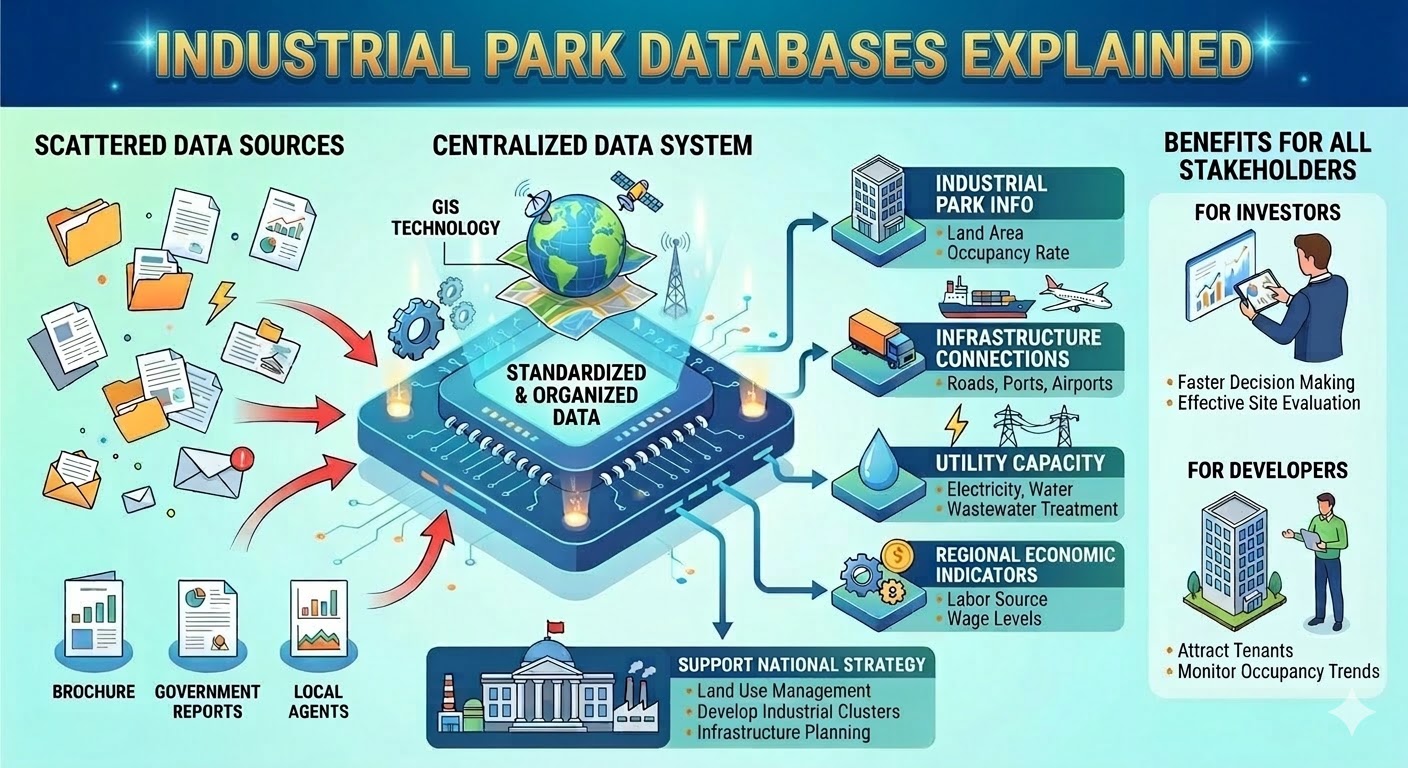
Industrial parks have become the backbone of modern manufacturing economies. Across Asia alone, thousands of industrial parks host factories that power exports, create employment, and drive regional development. Yet for many investors, understanding where these parks are located, what infrastructure they provide, and whether land is available remains surprisingly difficult.
This challenge highlights the importance of industrial park databases—structured digital systems that collect, organize, and present information about industrial zones in a way that supports investment decisions. As manufacturing investment becomes more data-driven, these databases are emerging as a critical tool for both investors and policymakers.
1. What Is an Industrial Park Database?
An industrial park database is a centralized repository that stores and organizes detailed information about industrial zones and manufacturing clusters. Instead of relying on scattered brochures, government reports, or local brokers, investors can access structured data through a single platform.
A comprehensive industrial park database typically includes information such as land size, occupancy rates, infrastructure connectivity, utility capacity, and available plots for development. Some advanced systems also integrate geographic information systems (GIS) to visualize industrial parks on interactive maps.
This structured approach transforms raw data into actionable intelligence, enabling investors to quickly evaluate multiple locations.
2. Why Industrial Park Data Is Often Difficult to Access
Despite the importance of industrial parks in national economies, reliable data about them is often fragmented.
Several factors contribute to this problem. Industrial parks may be managed by different developers, provincial authorities, or economic zones, each maintaining its own information system. Data is frequently updated at different intervals, making it difficult to determine which information is current.
In addition, many industrial park datasets remain locked within static documents or government portals that are not designed for investor analysis. As a result, investors often spend significant time gathering information before they can even begin comparing potential factory locations.
Industrial park databases solve this problem by consolidating and standardizing data across multiple sources.
3. Core Data Inside an Industrial Park Database
A well-designed industrial park database organizes information into several key categories that are essential for manufacturing investors.
Land availability and occupancy: Investors need to know which plots are available and how much land remains in each park. Occupancy rates also provide insight into demand and expansion potential.
Infrastructure connectivity: Data on highways, ports, airports, and rail networks helps investors evaluate logistics efficiency and supply chain access.
Utility capacity: Electricity, water supply, wastewater treatment, and telecommunications infrastructure are critical for manufacturing operations.
Regional economic indicators: Information about labor availability, wage levels, and surrounding industrial clusters helps investors understand the broader industrial ecosystem.
By structuring these datasets in a consistent format, databases allow investors to compare industrial parks across different regions more effectively.
4. The Role of GIS in Industrial Park Databases
Geographic Information Systems (GIS) have become a key component of modern industrial park databases. While traditional databases list information in tables, GIS platforms add a spatial dimension by mapping industrial parks and related infrastructure.
This spatial perspective allows investors to visualize relationships that are difficult to interpret in text or spreadsheets. For example, investors can instantly see how close a park is to a seaport, a major highway corridor, or a supplier cluster.
GIS integration transforms industrial park databases from static information systems into interactive decision-making tools.
5. Benefits for Investors and Developers
Industrial park databases offer several important advantages for stakeholders across the industrial ecosystem.
For investors, centralized data significantly reduces the time required to identify and evaluate potential factory locations. Instead of relying on informal information channels, investors can conduct preliminary analysis through structured datasets.
For developers, these platforms increase visibility for their industrial parks and help attract new tenants. Accurate data also allows developers to monitor occupancy trends and plan future expansion more strategically. Ultimately, industrial park databases create a more transparent and efficient industrial real estate market.
6. Supporting National Industrial Strategy
Beyond individual investment decisions, industrial park databases also support national economic planning.
Governments can use centralized datasets to monitor land utilization, track industrial cluster development, and identify regions where infrastructure investment is needed. By analyzing patterns in industrial occupancy and expansion, policymakers can design more effective industrial strategies.
In this sense, industrial park databases function as digital infrastructure for industrial policy, helping align private investment with long-term development goals.
7. The Future of Industrial Data Platforms
As global manufacturing becomes increasingly competitive, access to reliable industrial data will play an even greater role in investment decisions.
Future industrial park databases are likely to incorporate real-time occupancy tracking, predictive analytics, and artificial intelligence to forecast investment trends and infrastructure demand. These innovations will transform databases from passive repositories into proactive intelligence systems.
For countries seeking to attract manufacturing investment, building robust industrial data platforms is no longer optional. It is a critical step toward creating a transparent, data-driven industrial ecosystem that supports both investors and long-term economic growth.
(1).png)