The Future of Industrial Investment Data in Vietnam
Explore the future of industrial investment data in Vietnam, where centralized platforms, AI analytics, and real-time industrial intelligence are transforming how investors evaluate manufacturing locations.
 \
\
The Future of Industrial Investment Data in Vietnam
Vietnam has rapidly emerged as one of Asia’s most attractive manufacturing destinations. Over the past decade, global supply chain shifts, rising production costs in China, and regional trade agreements have pushed multinational corporations to diversify their manufacturing footprints. Vietnam has been one of the biggest beneficiaries of this transformation.
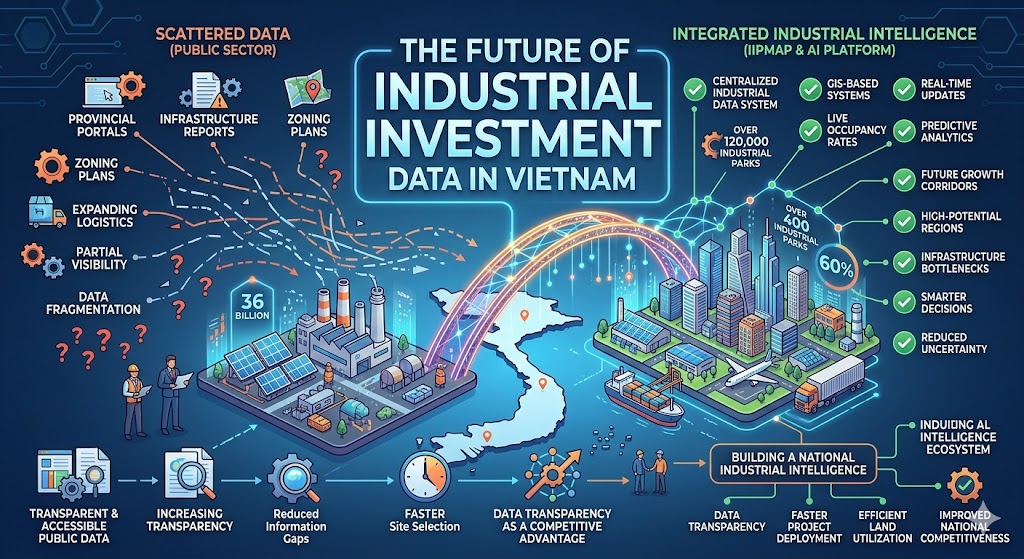
According to Vietnam’s Ministry of Planning and Investment, total registered foreign direct investment (FDI) reached more than $36 billion in 2023, with manufacturing accounting for nearly 60% of total inflows. At the same time, the country now operates over 400 industrial parks, covering more than 120,000 hectares of industrial land.
However, as the industrial ecosystem grows in scale and complexity, data transparency and accessibility are becoming critical bottlenecks. The future of industrial investment in Vietnam will increasingly depend on how effectively industrial data is collected, integrated, and analyzed.
1. Vietnam’s Industrial Expansion Is Outpacing Data Infrastructure
Vietnam’s industrial development has accelerated dramatically over the past two decades. New industrial zones are being developed in provinces across the country, while infrastructure projects such as expressways, ports, and logistics hubs continue to expand.
Yet the digital infrastructure that supports industrial investment decisions has not evolved at the same pace.
Information about industrial parks, land availability, occupancy rates, and infrastructure connectivity is often scattered across provincial reports, industrial park websites, and investment promotion documents. In many cases, the data is outdated or difficult to compare across regions.
This fragmentation creates uncertainty for investors attempting to identify the best locations for new factories or production facilities.
As Vietnam moves toward higher-value manufacturing and larger-scale investment projects, the need for centralized industrial data systems will become increasingly urgent.
2. Investors Are Demanding Data-Driven Location Decisions
Modern manufacturing investments involve large capital commitments and complex supply chain considerations. Companies expanding into new markets must evaluate multiple factors before selecting a factory location.
These factors include logistics connectivity, labor availability, infrastructure capacity, land pricing, environmental regulations, and proximity to existing industrial clusters.
In the past, site selection decisions were often based on broker recommendations or manual market research. Today, global manufacturers increasingly rely on data-driven site selection tools to reduce uncertainty and improve efficiency.
Access to structured industrial data allows investors to:
- Compare industrial parks across regions
- Evaluate infrastructure connectivity
- Analyze regional competitiveness
- Identify emerging industrial clusters
In this environment, countries that provide transparent and accessible industrial intelligence will have a significant advantage in attracting manufacturing investment.
3. The Role of Digital Industrial Intelligence Platforms
One of the most important developments in industrial investment data is the rise of industrial intelligence platforms.
These platforms integrate multiple data sources into a single digital environment where users can analyze industrial ecosystems in real time. Instead of navigating dozens of reports and government portals, investors gain a comprehensive view of industrial landscapes through interactive maps and analytics tools.
Typical datasets integrated into such platforms include:
- Industrial park locations and boundaries
- Land availability and occupancy rates
- Transportation infrastructure
- Logistics networks and port access
- Regional economic indicators
By visualizing these layers together, industrial intelligence platforms transform fragmented information into actionable insights. In Vietnam, platforms such as IIPMap are beginning to play this role by centralizing industrial data and presenting it through GIS-based systems.
4. From Static Reports to Real-Time Industrial Data
Historically, industrial investment information has been distributed through static documents such as planning reports, PDFs, and government publications. While these sources remain important, they often lack the real-time updates required for fast-moving investment decisions.
The future of industrial investment data will increasingly rely on dynamic and continuously updated datasets. Real-time industrial intelligence could include:
- Live industrial park occupancy rates
- Infrastructure construction progress
- Factory development status
- Logistics capacity utilization
Such real-time insights allow investors to identify opportunities faster and avoid delays caused by outdated information. For policymakers and industrial park developers, real-time data also improves monitoring of land utilization and infrastructure performance.
5. AI and Predictive Analytics Will Transform Industrial Planning
Beyond simply visualizing data, emerging technologies such as artificial intelligence and predictive analytics are beginning to transform industrial planning.
By analyzing historical investment patterns, infrastructure expansion, and regional economic indicators, AI systems can help forecast where new industrial clusters are likely to emerge.
Predictive models may be able to identify:
- Future industrial growth corridors
- Infrastructure bottlenecks
- High-potential manufacturing regions
- Land demand trends in specific provinces
These insights can help governments plan industrial development more effectively and guide investors toward high-growth regions.
In the coming decade, predictive analytics will likely become a key component of industrial investment platforms.
6. Data Transparency as a Competitive Advantage
As global competition for manufacturing investment intensifies, transparency will become a defining factor in industrial competitiveness.
Countries that provide reliable, centralized industrial data make it easier for investors to evaluate opportunities and move projects forward quickly.
Vietnam already possesses strong advantages in terms of labor competitiveness, trade agreements, and geographic location. By strengthening industrial data infrastructure, the country can further enhance its attractiveness as a global manufacturing hub.
Transparent industrial intelligence systems reduce uncertainty, accelerate site selection processes, and build investor confidence.
7. Building Vietnam’s Industrial Data Ecosystem
The future of industrial investment in Vietnam will depend on collaboration between government agencies, industrial park developers, technology platforms, and investors. Creating a comprehensive industrial data ecosystem requires:
- Standardized industrial park data reporting
- Integration of infrastructure and logistics datasets
- GIS-based mapping of industrial zones
- Real-time monitoring of land utilization
- Open access to investment-relevant information
Platforms that centralize and structure this information will become essential tools for both investors and policymakers.
As Vietnam continues to integrate into global supply chains, the ability to transform industrial data into strategic intelligence will shape the next phase of the country’s manufacturing growth.
(1).png)