How IIPMap Helps Foreign Investors Reduce Risk
Discover how IIPMap helps foreign investors reduce industrial investment risk in Vietnam by centralizing industrial park data, infrastructure insights, and GIS-based site selection intelligence.
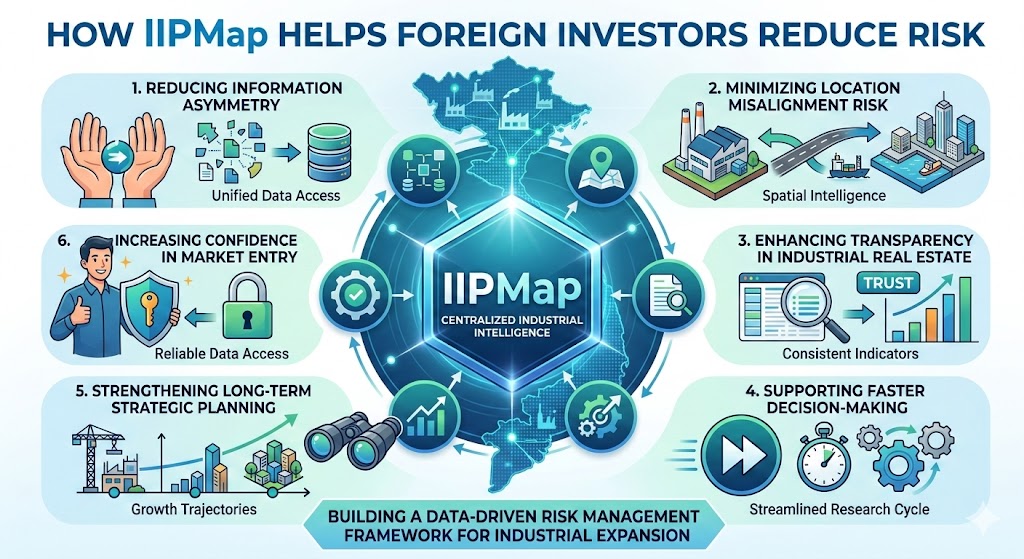
How IIPMap Helps Foreign Investors Reduce Risk
Entering a new manufacturing market is never just a growth decision—it is a risk management decision. For foreign investors, industrial expansion into countries like Vietnam offers strong opportunities, but it also presents uncertainties related to infrastructure readiness, land transparency, regulatory clarity, and long-term regional competitiveness.
In fast-growing industrial markets, the difference between a successful factory project and a costly misstep often lies in the quality of data available during site selection.
IIPMap addresses this challenge by functioning as a centralized industrial intelligence platform, helping foreign investors reduce uncertainty and make more informed, data-driven decisions.
1. Reducing Information Asymmetry
One of the primary risks foreign investors face is information asymmetry. Local stakeholders—developers, brokers, or authorities—often possess fragmented pieces of data that may not provide a complete picture.
Industrial park occupancy rates, infrastructure capacity, zoning approvals, and expansion plans may be stored across different provincial systems. Without consolidation, investors must manually verify each data point, increasing due diligence costs and project delays.
IIPMap reduces this asymmetry by centralizing industrial park data, infrastructure mapping, and regional development information into a single structured platform.
Instead of navigating multiple disconnected sources, investors gain access to a unified view of Vietnam’s industrial landscape.
2. Minimizing Location Misalignment Risk
Selecting the wrong location can create long-term operational inefficiencies. A factory that appears strategically positioned based on land price alone may face hidden constraints such as weak logistics connectivity, limited labor access, or insufficient utility infrastructure.
Vietnam currently operates more than 400 industrial parks, with occupancy rates exceeding 80% in major industrial provinces. In such a competitive environment, land availability alone does not guarantee suitability.
IIPMap enables foreign investors to cross-reference industrial land availability with:
- Highway and expressway networks
- Port and airport proximity
- Urban population centers
- Regional industrial clusters
This spatial intelligence helps companies evaluate whether a site aligns with their supply chain strategy before committing capital.
3. Enhancing Transparency in Industrial Real Estate
Transparency is a major factor influencing foreign investment confidence. In emerging markets, inconsistent or outdated information can significantly increase perceived risk.
IIPMap improves transparency by structuring industrial data into a clear, comparable format. Investors can evaluate multiple provinces and industrial zones using consistent indicators rather than relying solely on marketing materials or informal channels.
Greater transparency leads to:
- Faster preliminary screening
- Reduced negotiation uncertainty
- More accurate feasibility studies
By improving data clarity, IIPMap lowers the probability of unexpected constraints during project implementation.
4. Supporting Faster Decision-Making
Time is a critical risk variable in global manufacturing. Delays in site selection can postpone production timelines and weaken competitive positioning.
Traditional site selection often requires weeks of manual research, consultations, and cross-verification. IIPMap streamlines this process through GIS-based visualization and integrated datasets.
Foreign investors can quickly analyze:
- Industrial park distribution nationwide
- Infrastructure connectivity
- Regional competitiveness patterns
By shortening the research cycle, IIPMap reduces opportunity cost and accelerates strategic expansion decisions.
5. Strengthening Long-Term Strategic Planning
Risk reduction is not only about avoiding immediate mistakes—it is also about anticipating future developments.
Infrastructure projects, regional planning updates, and industrial cluster growth can significantly affect long-term factory performance. A location that appears optimal today may face congestion or land scarcity tomorrow.
IIPMap provides a broader perspective by integrating infrastructure data and industrial development patterns, helping investors evaluate not only current conditions but also regional growth trajectories.
This strategic visibility supports more resilient investment decisions.
6. Increasing Confidence in Market Entry
Foreign investors entering Vietnam often conduct extensive due diligence to evaluate regulatory and operational risks. A centralized industrial intelligence platform strengthens confidence by demonstrating that reliable data is accessible and structured.
When investors can independently analyze industrial ecosystems rather than relying solely on intermediaries, perceived market risk declines.
In this sense, IIPMap does more than provide information—it contributes to building a more transparent and investor-friendly industrial environment.
7. Building a Data-Driven Risk Management Framework
As global supply chains become more diversified, manufacturing investment decisions increasingly rely on digital intelligence.
IIPMap supports foreign investors by offering:
- Centralized industrial park databases
- Infrastructure cross-referencing
- Geographic visualization tools
- Structured industrial market insights
By transforming fragmented data into actionable intelligence, the platform enables companies to approach industrial expansion with greater clarity and reduced uncertainty.
In a competitive manufacturing landscape, risk cannot be eliminated—but it can be significantly reduced through better information. IIPMap positions itself as a strategic tool that helps foreign investors navigate Vietnam’s industrial market with confidence, transparency, and data-driven precision.
(1).png)