Data Transparency: The Key to Successful Manufacturing Entry
Data transparency helps manufacturers enter new markets successfully by providing reliable insights into industrial land, infrastructure, and labor conditions, enabling smarter and lower-risk factory location decisions.
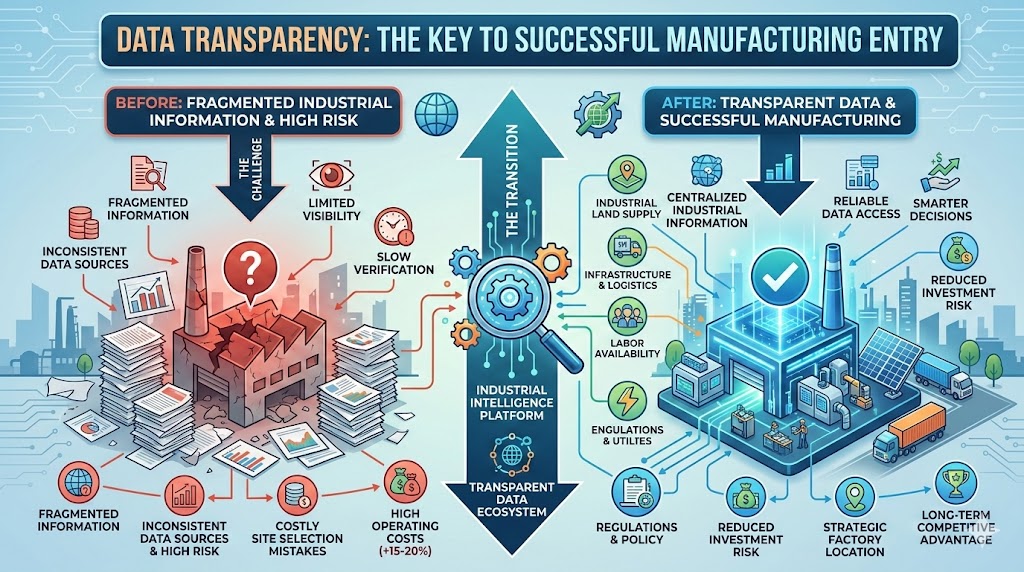
Data Transparency: The Key to Successful Manufacturing Entry
1. When Manufacturing Investment Fails Before Production Begins
Many manufacturing projects do not fail because of weak demand or poor technology. Instead, problems often emerge much earlier—during the location selection stage.
Factories built in the wrong locations frequently encounter unexpected obstacles: overloaded logistics routes, limited energy capacity, labor shortages, or regulatory complications. These issues are rarely visible at the beginning of the investment process, especially when investors rely on incomplete or outdated information.
In fact, several global investment reports indicate that site-related inefficiencies can increase long-term operating costs by 15–20% for manufacturing facilities. When multiplied over decades of factory operations, this becomes a substantial financial burden.
At the center of this challenge lies one critical factor: data transparency.
2. Manufacturing Entry Is No Longer a Simple Location Choice
Entering a new manufacturing market today requires navigating a complex ecosystem of infrastructure, industrial policy, labor availability, and logistics connectivity.
In the past, investors often evaluated locations based on a few primary indicators such as land prices or tax incentives. However, modern manufacturing requires a far deeper understanding of the industrial environment.
A successful factory location typically depends on the interaction of several key elements:
- Industrial land supply and occupancy levels
- Proximity to ports, highways, and logistics corridors
- Workforce availability and urban development
- Energy infrastructure and utility reliability
- Environmental regulations and zoning policies
Without transparent access to this information, investors may struggle to evaluate locations accurately.
3. The Cost of Fragmented Industrial Information
In many emerging manufacturing markets, industrial data remains fragmented. Information about industrial parks, infrastructure networks, and regional development plans is often distributed across multiple institutions and databases.
As a result, investors frequently face three major challenges:
- Limited visibility: Reliable information about industrial land availability or infrastructure readiness may not be publicly accessible.
- Inconsistent data sources: Different agencies or developers may publish conflicting information about the same industrial zone.
- Slow verification processes: Investors often need to conduct multiple site visits and consultations to confirm basic information.
This fragmented information environment slows down investment decisions and increases uncertainty during market entry.
4. Why Transparency Reduces Investment Risk
Data transparency plays a critical role in reducing risk during the manufacturing entry process. When investors have access to accurate and structured information, they can evaluate potential factory locations more effectively.
Transparent data enables investors to:
- Compare industrial zones across different regions
- Identify infrastructure limitations early
- Understand regional labor dynamics
- Assess long-term development potential
This information helps companies avoid costly mistakes such as selecting locations that lack sufficient logistics connectivity or utility capacity.
More importantly, transparency allows investors to move from reactive decision-making to proactive strategic planning.
5. The Role of Digital Industrial Intelligence Platforms
Digital transformation is gradually reshaping how industrial investment decisions are made. Modern investors increasingly rely on industrial intelligence platforms that combine geographic data, infrastructure mapping, and economic indicators.
These platforms consolidate previously fragmented datasets into unified digital environments. Through interactive maps and analytical dashboards, users can visualize industrial landscapes and identify strategic investment opportunities.
For example, a digital platform can allow investors to analyze:
- Industrial park locations and available land
- Transportation networks and logistics hubs
- Regional population and workforce distribution
- Energy infrastructure and development plans
By integrating these data layers, investors gain a much clearer understanding of how different locations support manufacturing operations.
6. Transparency as a Competitive Advantage for Investment Destinations
Countries and regions that provide transparent industrial data often gain a strong advantage in attracting foreign investment. When reliable information is easily accessible, investors can evaluate opportunities more quickly and confidently.
In contrast, markets with limited data transparency may discourage potential investors, even if they offer competitive labor costs or attractive incentives.
Transparent data ecosystems enable governments and industrial developers to:
- Showcase infrastructure readiness
- Highlight regional industrial clusters
- Demonstrate long-term development planning
- Attract strategic manufacturing investment
In this sense, transparency becomes more than an information tool—it becomes an investment promotion strategy.
7. Building the Foundation for Smarter Industrial Expansion
As global supply chains continue to evolve, manufacturing companies will increasingly prioritize data-driven investment strategies. Transparent industrial data helps investors identify optimal locations, reduce uncertainty, and plan long-term operations more effectively.
At the same time, digital platforms that centralize industrial information are creating new possibilities for smarter site selection and industrial planning.
In the coming decade, the success of manufacturing entry into new markets will depend not only on traditional factors such as labor costs or tax incentives. Instead, access to reliable, transparent data will become one of the most decisive factors shaping global industrial investment.
(1).png)