ESG as a Competitive Advantage for Industrial Parks
ESG is becoming a key competitive advantage for industrial parks. Sustainable infrastructure, responsible governance, and social initiatives help attract global manufacturing investment and strengthen industrial ecosystems.
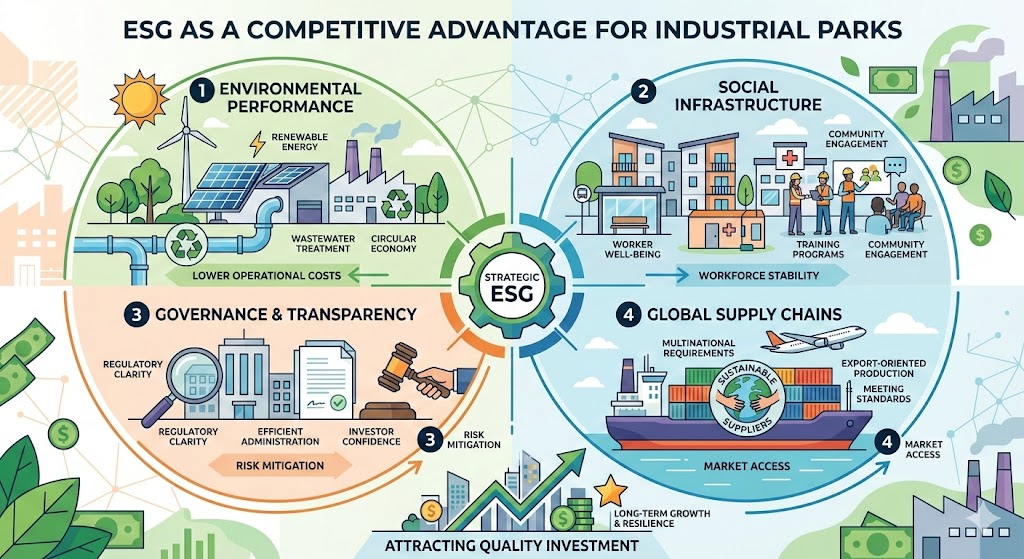
ESG as a Competitive Advantage for Industrial Parks
1. From Compliance to Competitive Strategy
For many years, environmental and social standards were viewed mainly as regulatory requirements. Industrial parks implemented environmental policies primarily to comply with government regulations. Today, however, ESG—Environmental, Social, and Governance—has become a strategic factor that can significantly influence investment decisions.
Global manufacturers increasingly integrate ESG criteria into their location strategies. According to the World Economic Forum, more than 80% of global investors now consider ESG factors when making long-term investment decisions. This shift means that industrial parks capable of meeting ESG standards can gain a clear competitive advantage in attracting foreign direct investment.
Instead of being a compliance burden, ESG is gradually becoming a key differentiator in the global competition for manufacturing investment.
2. Environmental Performance and Sustainable Infrastructure
Environmental responsibility is often the most visible dimension of ESG in industrial development. Manufacturing activities consume large amounts of energy, water, and raw materials, which makes environmental management a central concern for investors.
Industrial parks that prioritize sustainable infrastructure typically focus on several key areas:
- Renewable energy integration, including solar power and energy-efficient systems
- Centralized wastewater treatment facilities
- Circular economy initiatives that recycle industrial by-products
- Green spaces and ecological buffers within industrial zones
Programs supported by the United Nations Industrial Development Organization have demonstrated that eco-industrial parks can reduce energy consumption by 10–15% and lower water usage by up to 20% through resource-sharing systems between companies.
Such improvements not only benefit the environment but also reduce operational costs for manufacturers.
3. Social Infrastructure Supports Workforce Stability
The social dimension of ESG is becoming increasingly important in industrial zones. Manufacturing operations depend heavily on a stable workforce, and industrial parks that invest in social infrastructure often gain long-term advantages.
Key social initiatives include:
- Worker housing and transportation systems
- Healthcare and safety standards within industrial facilities
- Vocational training partnerships with local institutions
- Community engagement programs
According to research from the International Labour Organization, improved workplace conditions and training opportunities can increase worker productivity by more than 20% in manufacturing environments.
Industrial parks that support worker well-being therefore create stronger and more sustainable industrial ecosystems.
4. Governance and Transparency Build Investor Confidence
The governance component of ESG focuses on transparency, regulatory clarity, and responsible management practices. Investors increasingly prefer industrial parks that provide clear legal frameworks, transparent land-use policies, and predictable administrative procedures.
Strong governance reduces uncertainty for manufacturers planning long-term investments. Factories often operate for decades, so companies seek locations where regulations remain stable and administrative processes are efficient.
Industrial parks that maintain transparent governance structures tend to attract higher-quality investors and long-term manufacturing commitments.
5. ESG and the Changing Priorities of Global Supply Chains
ESG standards are also reshaping global supply chains. Many multinational corporations now require suppliers and manufacturing partners to meet environmental and social compliance standards.
For example, companies such as Apple and Nike have introduced strict sustainability requirements across their supply chains. Manufacturing partners must demonstrate responsible environmental management, worker protection policies, and transparent governance systems.
Industrial parks that support these standards make it easier for manufacturers to comply with global supply chain requirements. As a result, ESG-friendly industrial zones become more attractive locations for export-oriented production.
6. The Financial Benefits of ESG-Oriented Industrial Development
Beyond regulatory and reputational advantages, ESG can also deliver measurable economic benefits. Sustainable infrastructure often reduces energy consumption, improves resource efficiency, and lowers long-term operating costs.
A report by McKinsey & Company estimates that companies implementing strong ESG practices can achieve operational cost reductions of up to 20–30% through improved resource efficiency and risk management.
For industrial park developers, ESG investments can increase occupancy rates, attract multinational tenants, and strengthen the long-term value of industrial real estate assets.
7. ESG as the Future of Industrial Competitiveness
The global industrial landscape is evolving rapidly. Investors are no longer evaluating industrial parks based solely on land price or infrastructure quality. Environmental performance, social responsibility, and governance transparency are now central components of industrial competitiveness.
Industrial parks that embrace ESG principles early will be better positioned to attract high-quality manufacturing investment in the coming decades. By combining sustainable infrastructure, responsible governance, and strong community integration, these industrial zones can create resilient ecosystems that support both economic growth and environmental sustainability.
In this new era of global manufacturing, ESG is no longer an optional framework—it is becoming a strategic advantage.
(1).png)