Green Manufacturing Locations in Vietnam
Green manufacturing locations in Vietnam are attracting global investors seeking sustainable production. Eco-industrial parks, renewable energy, and green infrastructure are shaping the future of manufacturing investment.
Green Manufacturing Locations in Vietnam
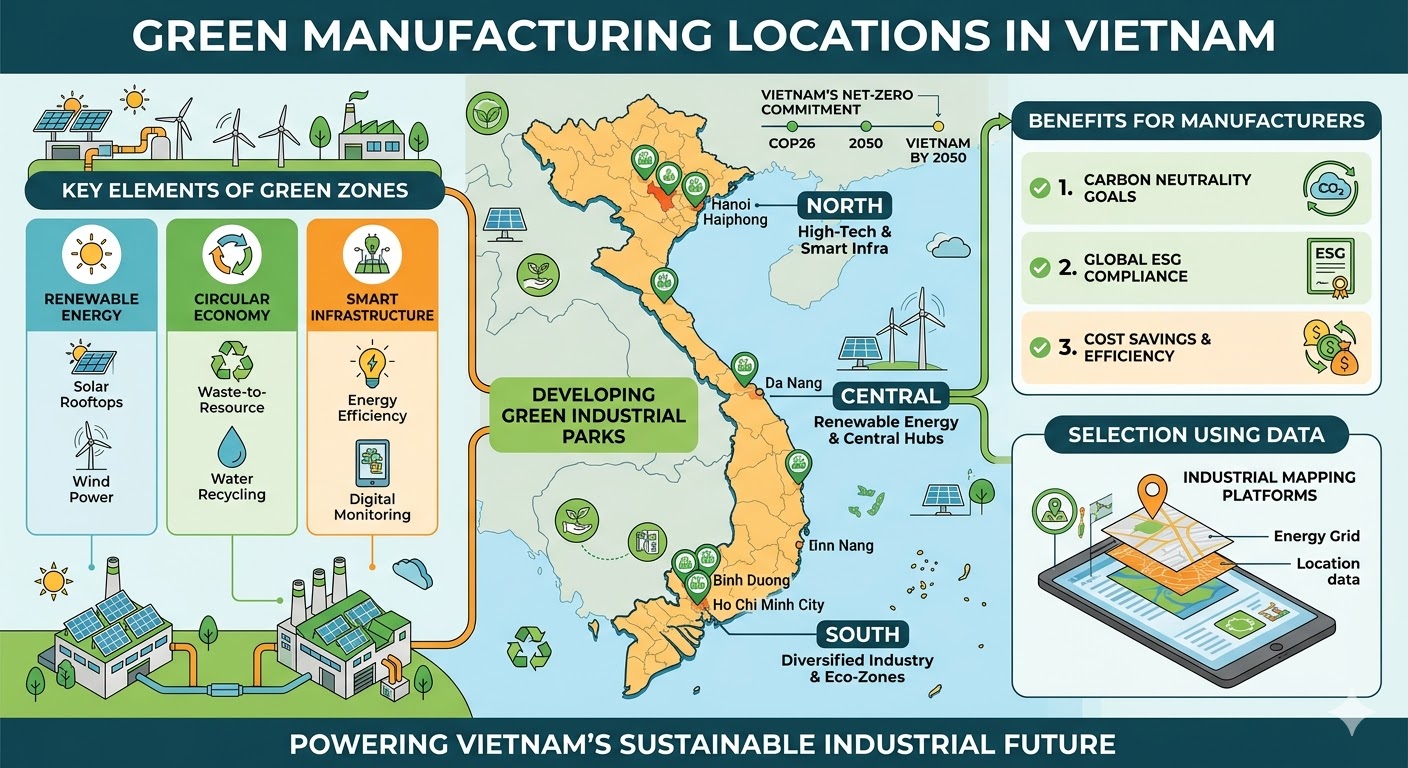
Sustainability is rapidly becoming a defining factor in global manufacturing decisions. As multinational corporations commit to carbon neutrality and ESG standards, the choice of manufacturing location increasingly depends on environmental performance, renewable energy access, and green infrastructure.
Vietnam has emerged as one of the most attractive manufacturing destinations in Asia. Alongside its competitive labor costs and strong export networks, the country is now developing green manufacturing locations that align with global sustainability requirements. Industrial parks integrating renewable energy, energy efficiency, and environmental management are becoming important magnets for foreign investment.
1. The Rising Importance of Green Manufacturing
Manufacturers worldwide are under growing pressure to reduce carbon emissions and adopt sustainable production practices. Large global brands are demanding greener supply chains, while governments and financial institutions increasingly link investment decisions to environmental standards.
According to the International Energy Agency (IEA), industry accounts for nearly 37% of global energy consumption and roughly 24% of CO₂ emissions. As a result, the environmental performance of manufacturing facilities is now a major consideration in investment planning.
Companies selecting factory locations today must evaluate not only logistics and costs but also the availability of:
- Renewable energy sources
- Environmental infrastructure
- Sustainable industrial ecosystems
Green manufacturing locations help companies meet these requirements while maintaining operational efficiency.
2. Vietnam’s Push Toward Sustainable Industrial Development
Vietnam has made significant commitments toward sustainable development and green growth. The government has pledged to achieve net-zero carbon emissions by 2050, a target announced at COP26.
To support this goal, Vietnam is encouraging the development of eco-industrial parks and environmentally responsible industrial zones. These industrial parks focus on reducing emissions, improving energy efficiency, and promoting circular industrial models where waste from one factory becomes input for another.
Many newly developed industrial parks are incorporating:
- Solar rooftop systems
- Wastewater recycling facilities
- Energy-efficient infrastructure
- Smart environmental monitoring systems
These initiatives help attract global manufacturers that prioritize sustainability in their supply chains.
3. Key Regions for Green Manufacturing in Vietnam
Several regions across Vietnam are becoming hubs for sustainable manufacturing due to their infrastructure readiness and investment in environmentally responsible industrial zones.
Northern provinces are attracting high-tech manufacturers seeking stable energy supply and modern infrastructure. Southern industrial corridors continue to host diversified manufacturing sectors while gradually integrating green energy solutions.
Central Vietnam, with its expanding renewable energy capacity—particularly wind and solar power—also presents opportunities for companies looking to reduce their carbon footprint.
The combination of industrial infrastructure and renewable energy resources is creating new opportunities for green manufacturing investment across the country.
4. Eco-Industrial Parks and Circular Production Models
A key feature of green manufacturing locations is the development of eco-industrial parks, where companies collaborate to improve resource efficiency.
In these parks, waste heat, water, or by-products generated by one factory may be reused by neighboring facilities. This circular approach significantly reduces resource consumption and environmental impact.
Eco-industrial parks typically incorporate:
- Shared environmental infrastructure
- Industrial symbiosis between factories
- Efficient waste and water management systems
- Renewable energy integration
This model allows manufacturers to reduce operational costs while meeting strict environmental standards required by international markets.
5. Renewable Energy and Sustainable Power Supply
Energy is one of the most important factors for sustainable manufacturing. Vietnam has experienced rapid growth in renewable energy capacity, particularly in solar and wind power.
The country has become one of Southeast Asia’s fastest-growing renewable energy markets, with solar power capacity expanding dramatically over the past decade. Renewable electricity helps manufacturers reduce emissions and meet sustainability commitments required by global partners.
Industrial parks that integrate renewable energy sources are therefore becoming increasingly attractive to foreign investors seeking environmentally responsible production locations.
6. Digital Tools Supporting Green Location Selection
As sustainability becomes a critical factor in manufacturing investment, investors need access to reliable data about environmental performance and infrastructure readiness.
Digital industrial mapping platforms and data intelligence systems can help investors identify locations that support green manufacturing requirements. These platforms allow companies to analyze multiple factors simultaneously, including energy infrastructure, industrial land availability, and logistics connectivity.
By combining geographic data with environmental indicators, investors can more easily identify industrial zones that align with their sustainability strategies.
7. The Future of Green Manufacturing in Vietnam
Vietnam’s transition toward greener industrial development is likely to accelerate as global supply chains prioritize sustainability. International manufacturers increasingly favor locations that can support both efficient production and environmental responsibility.
Industrial parks that integrate renewable energy, eco-industrial systems, and modern environmental management will become key drivers of this transformation.
As Vietnam continues to strengthen its industrial infrastructure and sustainability policies, green manufacturing locations will play a central role in attracting the next wave of high-quality foreign direct investment.
(1).png)