High-Tech and Innovation Parks
High-tech and innovation parks integrate research, advanced manufacturing, and digital infrastructure. These ecosystems help attract technology investment, accelerate innovation, and support high-value industrial growth.
High-Tech and Innovation Parks
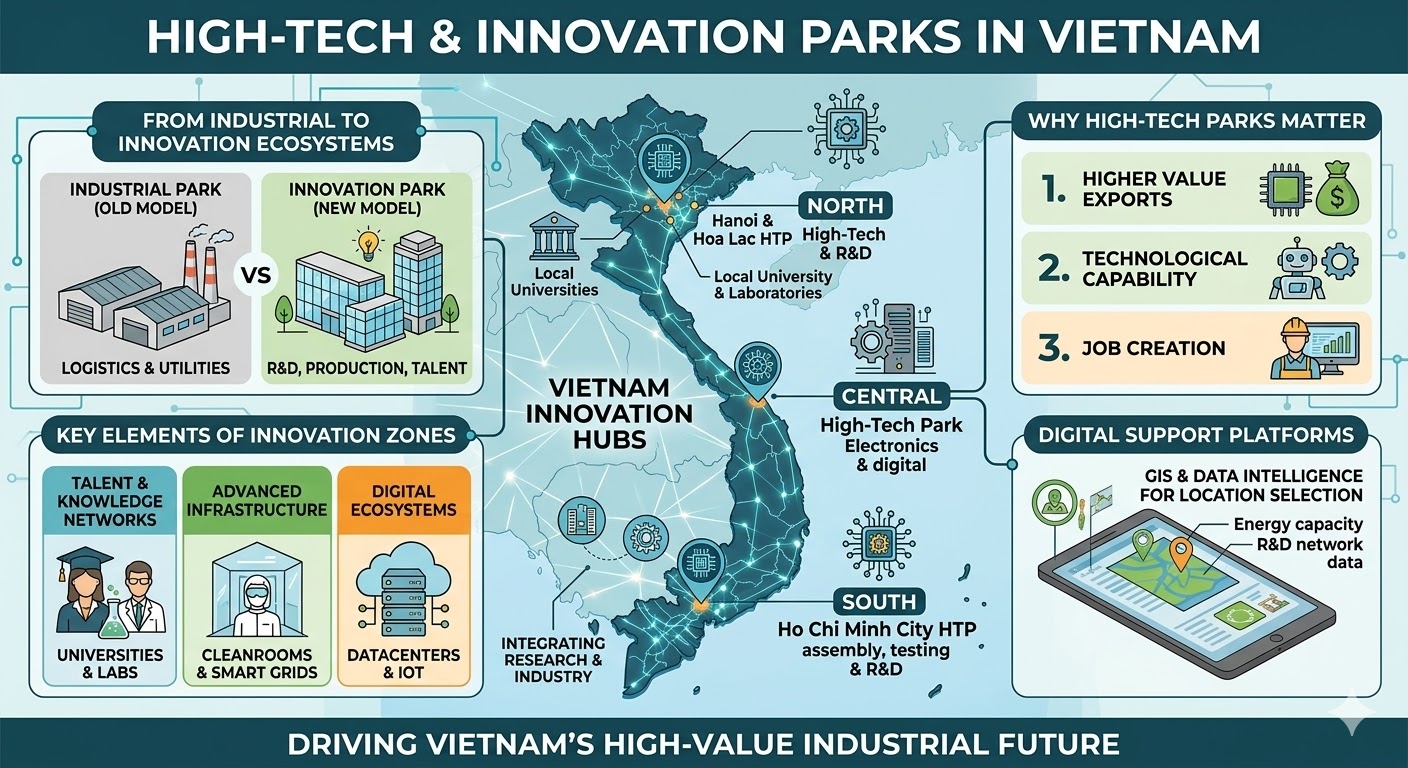
Manufacturing is no longer defined solely by factories and production lines. Increasingly, it is shaped by innovation ecosystems where research, technology development, advanced manufacturing, and digital infrastructure intersect. In this new industrial landscape, high-tech and innovation parks are emerging as strategic engines of economic transformation.
Unlike traditional industrial zones designed mainly for manufacturing capacity, high-tech parks function as integrated environments where technology companies, research institutions, startups, and global manufacturers collaborate to accelerate innovation. For countries aiming to move up the global value chain, these parks are becoming critical infrastructure for the next generation of industry.
1. From Industrial Parks to Innovation Ecosystems
Traditional industrial parks were primarily designed to provide land, utilities, and logistics connectivity. While this model successfully supported export-oriented manufacturing, it does not fully address the needs of modern technology-driven industries.
High-tech and innovation parks introduce a fundamentally different model. They combine production, research, and technological development within a single ecosystem. Companies located in these parks are not only manufacturing products but also developing new technologies, testing prototypes, and building intellectual property.
Several elements typically define these innovation-oriented parks:
- Proximity to universities and research institutions
- Access to highly skilled technical talent
- Infrastructure for laboratories and R&D facilities
- Digital infrastructure supporting advanced manufacturing
This integration enables faster innovation cycles and stronger collaboration between academia and industry.
2. Why High-Tech Parks Matter for Economic Upgrading
Countries that successfully develop high-tech industrial ecosystems often achieve stronger technological capabilities and higher-value exports. Instead of focusing only on labor-intensive manufacturing, these economies attract industries such as semiconductors, electronics, biotechnology, and advanced materials.
According to global manufacturing studies, high-tech industries generate significantly higher productivity levels compared with traditional manufacturing sectors. They also stimulate the development of supporting industries, engineering services, and technology startups.
High-tech parks therefore play a strategic role in helping countries transition from assembly-based manufacturing toward innovation-driven industrial growth.
3. Vietnam’s High-Tech Park Development
Vietnam has increasingly invested in high-tech parks as part of its long-term industrial strategy. These zones aim to attract technology-intensive industries and strengthen the country’s position within global electronics and technology supply chains.
Major high-tech parks across Vietnam focus on sectors such as:
- Electronics and semiconductor manufacturing
- Information technology and digital services
- Biotechnology and medical technology
- Automation and advanced manufacturing
These parks often provide specialized infrastructure designed for high-tech industries, including advanced laboratories, research centers, and modern production facilities. The presence of global technology companies within these parks has also helped attract supplier networks and supporting industries, further strengthening the innovation ecosystem.
4. The Role of Talent and Knowledge Networks
Technology-driven industries rely heavily on highly skilled engineers, scientists, and technicians. As a result, high-tech parks are typically developed near universities and research institutions to facilitate collaboration and talent development.
Knowledge exchange between universities, startups, and multinational corporations is a critical factor in building successful innovation ecosystems. This collaboration can take many forms, including joint research programs, technology incubation, and startup acceleration initiatives.
By creating environments where talent and technology interact continuously, innovation parks can significantly accelerate technological advancement and industrial competitiveness.
5. Infrastructure for Advanced Manufacturing
High-tech industries require a level of infrastructure that goes beyond traditional industrial park standards. Precision manufacturing, semiconductor production, and biotechnology facilities depend on stable utilities, controlled environments, and advanced technical infrastructure.
Typical infrastructure components in high-tech parks include:
- Reliable and high-quality power supply
- Advanced telecommunications and data networks
- Cleanroom facilities for semiconductor and electronics manufacturing
- Smart infrastructure for automation and digital production systems
These specialized infrastructure systems allow high-tech manufacturers to operate efficiently while maintaining strict technological standards.
6. Digital Platforms Supporting High-Tech Investment
As high-tech industries become more location-sensitive, investors require detailed information about industrial zones, infrastructure readiness, and innovation ecosystems.
Digital industrial intelligence platforms and geographic information systems (GIS) are increasingly used to evaluate potential investment locations. These tools allow investors to analyze industrial land availability alongside factors such as infrastructure capacity, research networks, and regional economic clusters.
Access to accurate and centralized industrial data significantly improves the efficiency of high-tech investment planning.
7. The Future of Innovation Parks in Emerging Economies
The global competition for technology investment is intensifying. Countries that successfully build strong innovation ecosystems will likely attract the next wave of high-value manufacturing and research activities.
For emerging industrial economies, high-tech parks represent more than just physical infrastructure. They are platforms for knowledge creation, technological development, and global economic integration.
As advanced manufacturing technologies continue to evolve—from artificial intelligence to smart factories—the importance of well-designed high-tech and innovation parks will only grow.
These parks will play a central role in shaping the future of industrial development, enabling countries to move beyond traditional manufacturing and toward a more innovation-driven economy.
(1).png)