How AI and GIS are Revolutionizing Industrial Real Estate in Vietnam
AI and GIS technologies are transforming Vietnam’s industrial real estate market. Discover how platforms like IIPMap centralize fragmented industrial data and enable smarter site selection.
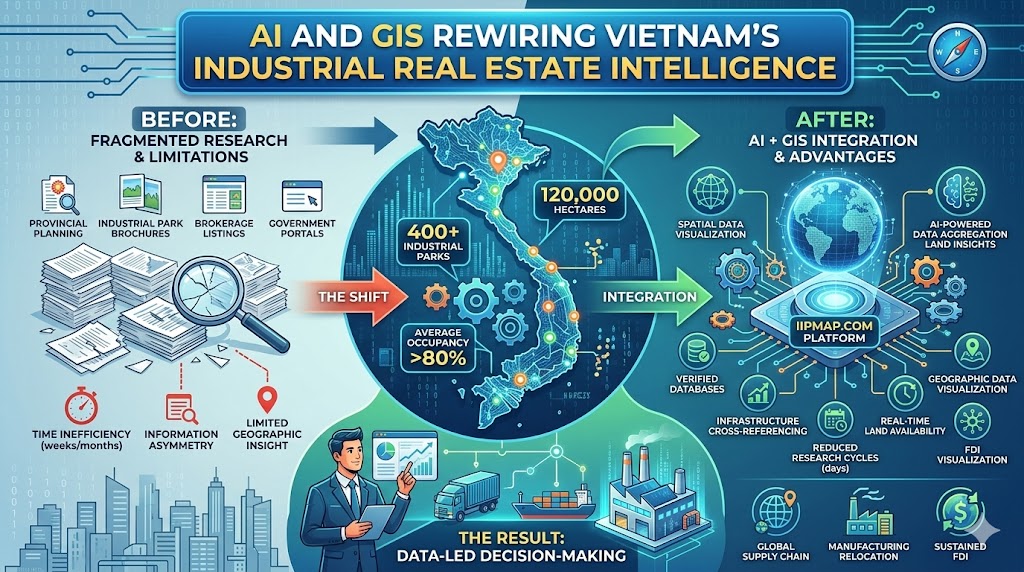
How AI and GIS Are Rewiring Vietnam’s Industrial Real Estate Intelligence
Vietnam’s industrial property market is expanding at unprecedented speed, fueled by global supply chain shifts, manufacturing relocation, and sustained foreign direct investment (FDI). However, the speed of investment decisions today often exceeds the speed of traditional industrial real estate research.
Manufacturers entering Vietnam can no longer rely on static reports, outdated brokerage listings, or fragmented provincial information. Instead, Artificial Intelligence (AI) and Geographic Information Systems (GIS) are emerging as the technologies redefining how industrial land is discovered, evaluated, and secured.
Platforms like IIPMap.com represent this transformation by integrating data intelligence, spatial analytics, and real-time industrial park information into a unified decision-making environment.
1. The Limits of Traditional Industrial Real Estate Research
For decades, industrial land selection followed a slow and manual process. Investors gathered data through multiple disconnected sources:
- Provincial planning documents
- Industrial park brochures
- Brokerage listings
- Government portals
- Consultant reports
Each source often presented partial or outdated information, forcing investors to manually compare infrastructure conditions, land availability, and regional incentives.
This fragmented approach introduces three major problems:
A. Time inefficiency
Industrial site research can take weeks or months before a viable shortlist emerges.
B. Information asymmetry
Developers, brokers, and local authorities often hold different pieces of information.
C. Limited geographic insight
Traditional reports rarely visualize spatial relationships between infrastructure, logistics networks, and industrial clusters.
In a competitive investment landscape, these limitations slow down decision-making and increase project risk.
2. Vietnam’s Industrial Boom Demands Smarter Data Tools
Vietnam has become one of Asia’s fastest-growing manufacturing destinations. According to the Vietnam Ministry of Planning and Investment, registered FDI reached USD 36.6 billion in 2023, with manufacturing accounting for more than 60% of total capital.
At the same time, the country’s industrial infrastructure continues to expand:
- Over 400 industrial parks nationwide
- Approximately 120,000 hectares of industrial land
- Average occupancy rates exceeding 80% in key regions such as Bac Ninh, Binh Duong, and Dong Nai
- Yet despite this rapid growth, industrial data remains highly fragmented across provinces and park operators.
This is where AI-driven analytics and GIS-based visualization tools begin to reshape the market.
3. AI + GIS: The New Intelligence Layer for Industrial Investment
The convergence of Artificial Intelligence and Geographic Information Systems enables industrial investors to evaluate locations through a completely different lens.
Instead of static listings, investors can now analyze dynamic industrial datasets mapped geographically in real time.
Key capabilities include:
A. Spatial Data Visualization
GIS technology transforms raw industrial data into interactive maps that reveal geographic patterns instantly. Investors can visualize:
- Industrial park distribution across provinces
- Proximity to highways, ports, and airports
- Regional manufacturing clusters
- Infrastructure connectivity
This spatial perspective allows investors to identify logistics advantages and supply chain efficiencies that are difficult to detect through spreadsheets or reports.
B. AI-Powered Data Aggregation
AI systems can automatically collect and organize industrial data from multiple sources, including:
- Government planning data
- Industrial park operators
- Infrastructure databases
- Market reports
The result is a structured, searchable dataset that removes duplication and reduces inconsistencies.
Platforms like IIPMap.com leverage AI to centralize fragmented industrial information, giving investors access to a single, reliable source of industrial intelligence.
C. Real-Time Industrial Land Insights
Traditional real estate reports quickly become outdated as occupancy rates change. With AI-driven systems, investors can monitor:
- Available industrial land
- Occupancy rates
- Expansion phases of industrial parks
- Infrastructure development progress
This real-time visibility dramatically improves investment timing, especially in high-demand industrial regions.
4. Why Industrial Investors Are Turning to Data Platforms
As Vietnam’s industrial market matures, data transparency and speed of analysis are becoming competitive advantages.
Investors today prioritize platforms that offer:
✔ Verified industrial park databases
✔ Infrastructure cross-referencing
✔ Geographic data visualization
✔ Real-time land availability updates
Instead of relying on scattered reports, decision-makers can evaluate multiple industrial locations simultaneously within a single digital interface.
This approach reduces research cycles from months to days.
5. IIPMap.com: A New Model for Industrial Location Intelligence
IIPMap.com represents the next evolution of industrial property research in Vietnam. The platform integrates AI-driven data aggregation with GIS-based spatial analysis, allowing investors to explore industrial parks through an interactive intelligence layer.
Key features include:
- Nationwide industrial park mapping
- Infrastructure proximity analysis
- Cross-referenced land availability data
- Centralized industrial market information
By combining location intelligence with structured industrial datasets, IIPMap.com helps investors move beyond traditional brokerage-driven research toward data-driven site selection.
6. The Future of Industrial Real Estate Is Data-Led
Industrial real estate is undergoing a structural shift. As supply chains become more complex and manufacturing investment accelerates, the ability to analyze industrial locations quickly and accurately becomes critical. AI and GIS technologies are not simply improving industrial research—they are redefining how industrial markets function.
In Vietnam’s rapidly evolving manufacturing landscape, platforms like IIPMap.com signal the emergence of a new paradigm: Industrial real estate powered by data intelligence rather than fragmented information.
For global manufacturers entering Vietnam, this transformation could mean the difference between a slow, uncertain search and a strategic, data-informed investment decision.
(1).png)