How AI Will Change Industrial Site Selection
Artificial intelligence is transforming industrial site selection by enabling data-driven analysis, predictive insights, and real-time location intelligence for manufacturing investment decisions.
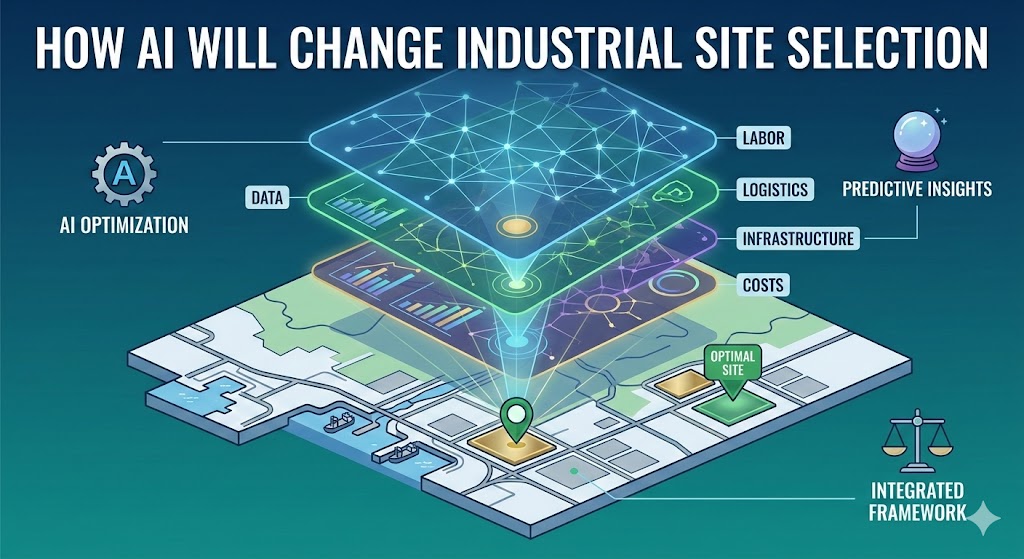
How AI Will Change Industrial Site Selection
1. From Intuition to Intelligent Analysis
For decades, industrial site selection relied heavily on experience, manual research, and fragmented datasets. Investors often depended on consultants, local contacts, and basic market reports to identify potential locations for factories or manufacturing facilities. While this approach sometimes worked, it also left room for significant uncertainty.
Artificial intelligence is rapidly transforming this process. Instead of relying primarily on human intuition, companies can now analyze massive volumes of geographic, economic, and infrastructure data within seconds. AI-powered systems are capable of identifying patterns, predicting risks, and evaluating thousands of potential locations simultaneously. As a result, industrial site selection is gradually evolving into a more precise, data-driven process.
2. AI Expands the Scale of Location Analysis
Traditional site selection methods usually evaluate a limited number of candidate locations due to time and resource constraints. Each potential site requires extensive research on infrastructure, labor supply, transportation access, and regulatory conditions. This process can take weeks or even months.
AI changes this dynamic by dramatically expanding the scale of analysis. Advanced algorithms can quickly process large datasets covering transportation networks, industrial land availability, labor demographics, logistics performance, and regional economic indicators. By comparing hundreds or even thousands of possible sites, AI helps investors identify locations that might otherwise be overlooked.
This broader perspective allows manufacturing companies to make more informed and strategic decisions when selecting industrial land.
3. Predictive Insights for Long-Term Investment
Manufacturing investments are long-term commitments, often designed to operate for decades. Choosing the right location therefore requires not only understanding present conditions but also anticipating future changes.
AI systems can analyze historical data and economic trends to generate predictive insights. For example, machine learning models can estimate future labor availability, forecast infrastructure development, or evaluate the potential growth of industrial clusters in specific regions.
These predictive capabilities help investors reduce uncertainty and select locations that will remain competitive over the long term. Instead of reacting to current market conditions, companies can plan with greater confidence about how a location may evolve.
4. Integrating Multiple Data Layers into One Decision Framework
Industrial site selection is inherently complex because it involves multiple interrelated factors. Transportation infrastructure, labor markets, environmental regulations, land prices, and logistics networks all influence the final decision.
AI platforms are capable of integrating these different data layers into a unified decision-making framework. Geographic information systems, satellite imagery, demographic statistics, and supply chain data can all be processed together to provide a comprehensive view of potential sites.
This integrated analysis allows investors to evaluate trade-offs more effectively. A location with slightly higher land costs, for instance, may prove far more advantageous if it offers better logistics connectivity and stronger labor availability.
5. Reducing Risk Through Real-Time Data
One of the most valuable contributions of AI in industrial site selection is its ability to incorporate real-time information. Economic conditions, infrastructure projects, and regulatory policies can change rapidly, and outdated data can lead to costly investment mistakes.
AI-powered systems can continuously update datasets from multiple sources, providing investors with more current and reliable insights. This dynamic approach reduces the risk of basing decisions on incomplete or outdated information.
By maintaining a constantly updated view of potential locations, companies can respond more quickly to emerging opportunities in the global manufacturing landscape.
6. Improving Collaboration Between Stakeholders
Industrial site selection rarely involves a single decision-maker. Investors, developers, government agencies, and logistics providers often participate in the evaluation process. AI platforms can facilitate collaboration by presenting complex data in clear, accessible formats.
Interactive dashboards, geospatial visualization tools, and automated scenario simulations help stakeholders better understand the advantages and limitations of different locations. This shared analytical framework supports more transparent and efficient decision-making across organizations.
As a result, industrial investment planning becomes more coordinated and strategically aligned.
7. The Future of Industrial Location Strategy
Artificial intelligence is not replacing human judgment in industrial site selection, but it is fundamentally enhancing it. Investors will continue to rely on experience and strategic insight, yet AI provides the analytical depth needed to navigate increasingly complex global manufacturing networks.
In the coming years, the integration of AI, big data, and geospatial technologies will likely become a standard component of industrial location strategy. Companies that adopt these tools early will gain a competitive advantage by identifying optimal manufacturing locations faster and with greater precision.
Ultimately, AI is reshaping industrial site selection into a smarter, more predictive process—one that enables investors to make better decisions in an increasingly data-driven industrial economy.
(1).png)