How IIPMap.com Centralizes Fragmented Industrial Data for Investors.
IIPMap.com centralizes fragmented industrial data into a single platform, helping investors analyze industrial parks, infrastructure, and labor markets to make faster, data-driven factory location decisions.
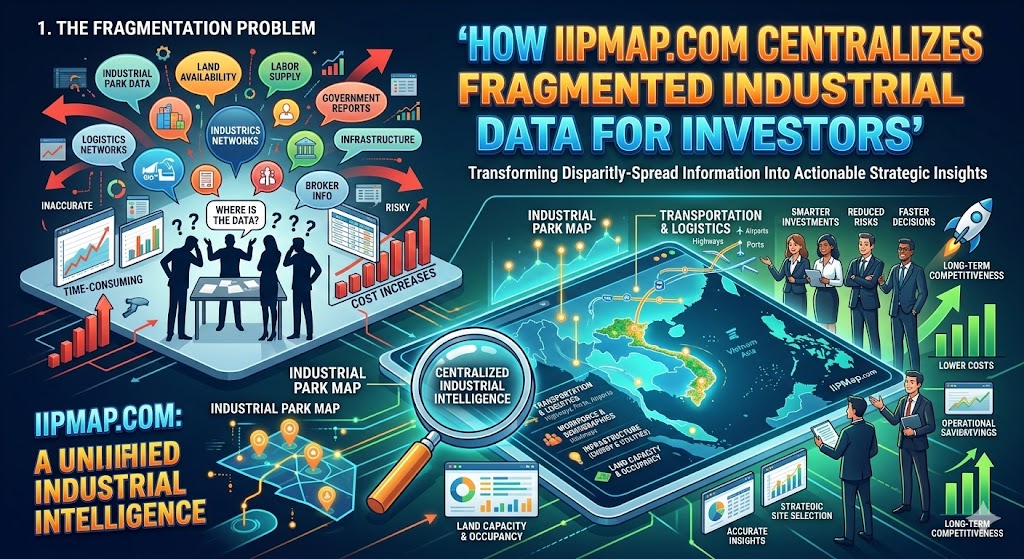
How IIPMap.com Centralizes Fragmented Industrial Data for Investors
1. The Fragmentation Problem in Industrial Investment
Industrial investment decisions increasingly depend on accurate and comprehensive data. Yet in many emerging manufacturing markets, including Vietnam and Southeast Asia, industrial information remains highly fragmented. Data about industrial parks, land availability, infrastructure, labor supply, and logistics networks is often scattered across government reports, local authorities, brokers, and private databases.
This fragmentation creates significant inefficiencies for investors. Instead of accessing a unified source of information, companies must spend weeks or even months collecting and verifying data from multiple channels. The lack of transparency can lead to misinformed site selection, delayed projects, and unexpected operational costs.
According to industry reports, industrial location decisions based on incomplete information can increase long-term operational costs by 15–20%, especially when logistics or infrastructure constraints are discovered only after a factory becomes operational.
2. Why Centralized Industrial Data Matters
As global manufacturing becomes more complex, investors must analyze multiple factors simultaneously. These include transportation connectivity, workforce availability, energy capacity, industrial cluster development, and environmental regulations.
Without centralized data systems, comparing locations across different regions becomes extremely difficult. Investors may identify attractive land prices in one industrial zone but overlook weak infrastructure or limited labor supply in surrounding areas.
Centralized industrial intelligence platforms solve this problem by consolidating diverse datasets into a single system, allowing investors to evaluate locations holistically rather than through fragmented information sources.
3. IIPMap.com: A Unified Industrial Intelligence Platform
IIPMap.com addresses this challenge by providing a centralized industrial intelligence platform designed specifically for investors and industrial developers. The platform aggregates critical data related to industrial investment and presents it through a structured, map-based interface.
Instead of relying on isolated reports, users can explore integrated datasets that include:
- Industrial park locations and development status
- Land availability and occupancy rates
- Transportation infrastructure such as highways, ports, and airports
- Labor supply distribution and population density
- Energy infrastructure and utilities
- Regional industrial planning and zoning information
By combining these data layers, IIPMap.com enables investors to understand the broader industrial ecosystem surrounding each location.
4. Turning Raw Data into Strategic Insights
The value of centralized industrial data goes beyond simple information aggregation. IIPMap.com transforms raw data into actionable insights that help investors make strategic decisions.
Through spatial analysis and geographic visualization, users can quickly identify patterns such as:
- Emerging industrial clusters
- Regions with strong logistics connectivity
- Industrial zones with available land capacity
- Areas experiencing rapid industrial expansion
For example, comparing industrial zones near major ports versus inland regions can reveal how logistics proximity affects long-term operational efficiency. Data-driven analysis helps investors avoid decisions based solely on short-term incentives or land prices, focusing instead on long-term competitiveness.
5. Improving Transparency in Industrial Real Estate
Transparency remains one of the biggest challenges in industrial real estate markets. Investors frequently face inconsistent information about land prices, infrastructure readiness, or development plans.
By centralizing industrial data, IIPMap.com improves market transparency. A unified platform allows investors to access verified and structured information, reducing dependence on fragmented brokerage sources.
Greater transparency benefits not only investors but also developers and policymakers. When reliable data becomes widely accessible, industrial markets operate more efficiently and investment decisions become more rational.
6. Faster and Smarter Investment Decisions
Time is a critical factor in industrial investment. Large-scale manufacturing projects often involve millions of dollars in capital and long-term operational commitments. Delays in site selection can slow down expansion plans or cause companies to lose competitive opportunities.
With centralized data platforms like IIPMap.com, investors can analyze multiple regions simultaneously and narrow down potential locations much faster than traditional research methods.
Instead of conducting lengthy manual studies, companies can visualize industrial landscapes instantly, compare infrastructure networks, and evaluate regional advantages with greater speed and accuracy.
7. Supporting the Future of Industrial Investment
As manufacturing continues to evolve under the influence of digital transformation, supply chain restructuring, and ESG requirements, access to reliable industrial data will become even more important.
Platforms like IIPMap.com represent a new generation of industrial intelligence tools. By centralizing fragmented information and transforming it into strategic insights, these platforms enable investors to make data-driven decisions that reduce risks and improve long-term performance.
In the future, industrial investment will increasingly rely on integrated digital systems that combine geographic data, infrastructure planning, and economic analysis. Centralized industrial intelligence platforms will play a key role in shaping how companies select factory locations and expand manufacturing operations across global markets.
(1).png)