IIPMap as a Bridge between Government Data and Investor Needs.
IIPMap bridges government industrial data and investor needs by centralizing planning, infrastructure, and industrial park information into a unified platform for smarter site selection.
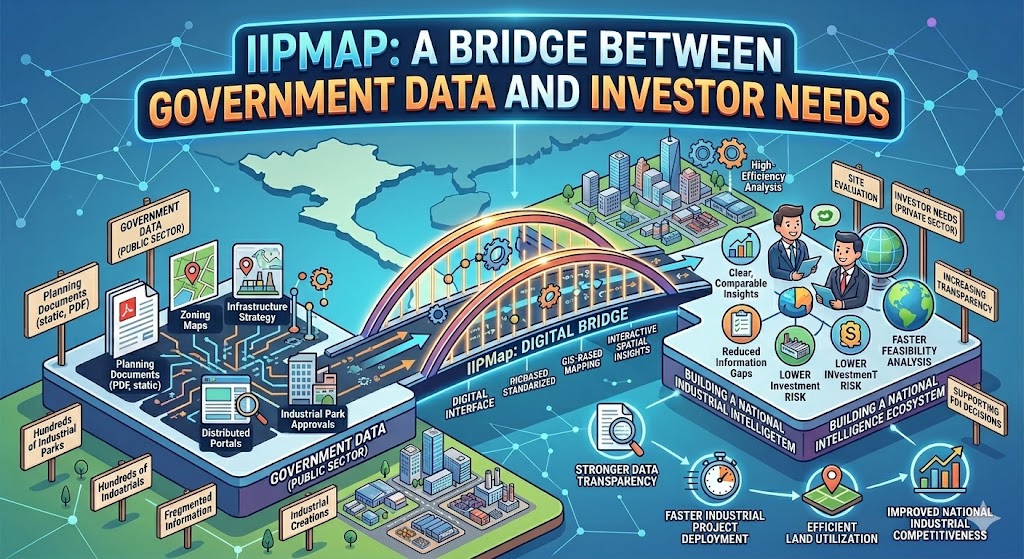
IIPMap as a Bridge between Government Data and Investor Needs
Vietnam’s industrial economy is expanding rapidly, driven by strong foreign direct investment (FDI), infrastructure upgrades, and supply chain diversification. Yet despite this growth, one structural gap remains: government industrial data and investor decision-making needs are rarely connected in a unified system.
Government agencies publish planning documents, infrastructure strategies, zoning maps, and industrial park approvals. Meanwhile, investors require clear, comparable, and actionable insights to evaluate factory locations.
IIPMap emerges as a digital bridge—transforming fragmented public-sector data into structured industrial intelligence for investors.
1. The Disconnect Between Public Data and Private Investment
Vietnam has developed hundreds of industrial parks nationwide, with occupancy rates in key provinces often exceeding 80%. Provincial authorities continuously publish planning updates, infrastructure roadmaps, and industrial development strategies.
However, this information is typically:
- Distributed across multiple government portals
- Presented in static PDF documents
- Lacking geographic visualization
- Difficult to compare across provinces
For investors evaluating industrial land, this fragmentation creates inefficiencies. Instead of analyzing a centralized dataset, they must manually gather and reconcile information from various sources.
The result is slower decision-making and higher due diligence costs.
2. Why Government Data Matters for Industrial Investors
Government data plays a critical role in industrial site selection. It shapes long-term industrial competitiveness in several ways:
- Zoning regulations determine land use eligibility
- Infrastructure planning defines future logistics connectivity
- Energy development plans affect utility reliability
- Industrial park approvals signal expansion capacity
- Urban planning influences labor availability
Without structured access to this information, investors risk selecting locations that appear viable today but may face constraints tomorrow.
Transparent and accessible public-sector data therefore becomes essential to support sustainable manufacturing investment.
3. IIPMap: Transforming Public Information into Investment Intelligence
IIPMap is designed to convert fragmented government datasets into a centralized industrial intelligence layer.
Instead of leaving data scattered across provincial systems, IIPMap aggregates and standardizes key industrial indicators into a unified digital platform. Through its interface, investors can explore:
- Industrial park locations and boundaries
- Land availability and occupancy levels
- Transportation networks and logistics corridors
- Infrastructure proximity to ports and airports
- Regional industrial development zones
By integrating these layers, IIPMap bridges the gap between regulatory information and practical investment analysis.
4. From Static Documents to Interactive Spatial Insights
Traditional government data often exists in static formats that are difficult to interpret spatially. For example, infrastructure expansion plans may be published without clear visualization of how they impact nearby industrial zones.
IIPMap leverages GIS-based mapping to transform such information into interactive spatial intelligence. Investors can visually analyze:
- How new expressways influence industrial accessibility
- Which parks benefit from port connectivity
- Where future industrial clusters may emerge
- How land supply aligns with regional planning
This geographic clarity enhances investor confidence and accelerates early-stage site screening.
5. Increasing Transparency in Industrial Real Estate
One of the persistent challenges in emerging industrial markets is information asymmetry. Developers, brokers, and local authorities may hold different pieces of data, making it difficult for investors to verify consistency.
By consolidating government-approved data into a structured environment, IIPMap contributes to greater transparency in industrial real estate. This transparency offers multiple benefits:
- Reduced information gaps
- Faster feasibility analysis
- Improved cross-provincial comparison
- Lower investment risk
When investors have reliable access to official planning and infrastructure data, industrial markets operate more efficiently.
6. Supporting Smarter FDI Decisions
Foreign investors entering Vietnam often evaluate dozens of potential industrial sites before narrowing down their shortlist. Access to centralized, structured public data significantly shortens this evaluation process.
Through IIPMap, investors can:
- Compare industrial zones across provinces
- Cross-reference infrastructure readiness with land supply
- Identify high-occupancy clusters
- Evaluate long-term development potential
This integration supports data-driven decision-making, allowing companies to align factory locations with long-term supply chain strategies rather than short-term incentives alone.
7. Building a National Industrial Intelligence Ecosystem
As Vietnam continues to attract manufacturing investment, the need for a unified industrial data ecosystem becomes increasingly important. IIPMap represents more than a listing platform. It functions as a digital infrastructure layer that connects public-sector data with private-sector investment decisions.
By acting as a bridge between government information and investor requirements, IIPMap contributes to:
- Stronger data transparency
- Faster industrial project deployment
- More efficient land utilization
- Improved national industrial competitiveness
In the long term, industrial growth will depend not only on land supply or labor costs but also on how effectively information flows between policymakers and investors. IIPMap positions itself at this intersection—turning public data into actionable investment intelligence.
(1).png)