IIPMap as Vietnam’s Industrial Intelligence Layer
IIPMap centralizes Vietnam’s industrial data, providing transparency, accurate forecasting, and data-driven insights to optimize investment decisions and strengthen competitive advantage.
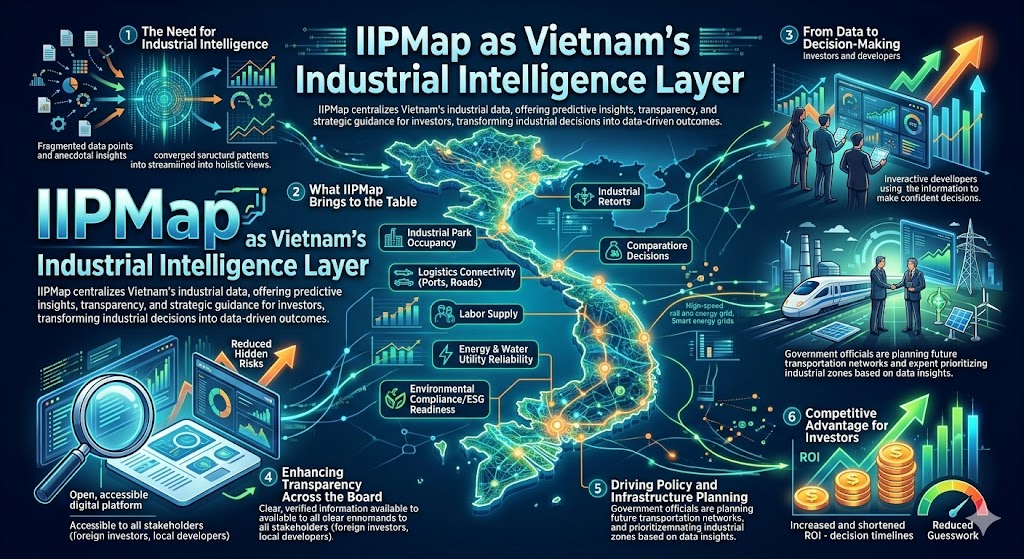
IIPMap as Vietnam’s Industrial Intelligence Layer
1. Vietnam’s Industrial Growth and Fragmentation
Over the past decade, Vietnam has emerged as one of the most attractive destinations for manufacturing investment, with FDI in the manufacturing sector exceeding USD 24 billion in 2025. Yet, this rapid growth comes with a major challenge: the industrial landscape remains fragmented and opaque. Many foreign investors and domestic businesses rely heavily on brokers, scattered information, or personal experience to choose factory locations. This often leads to unexpected costs, project delays, and missed opportunities, especially as industrial land in high-demand areas like Binh Duong and Hai Phong has surged 15–20% over the past three years.
2. IIPMap – A Unified Industrial Intelligence Solution
IIPMap serves as Vietnam’s central industrial intelligence layer, consolidating critical data for all investment decisions. It aggregates information on industrial park planning, logistics infrastructure, labor availability, energy supply, and ESG compliance, allowing investors to compare regions, forecast potential, and minimize risks.
For instance, IIPMap data shows that Quang Ninh and Hai Phong have industrial park occupancy rates around 65%, but lead the North in port connectivity and logistics, signaling strong export potential.
3. Turning Data into Strategic Decisions
The true power of IIPMap lies not in collecting data, but in transforming raw data into strategic decision-making tools. Investors can:
- Identify underutilized industrial land
- Forecast rent trends and operational costs for the next 5 years
- Evaluate labor access by skill levels and workforce size
Internal research based on IIPMap shows that data-driven location choices can reduce unforeseen costs by 18–25% compared to decisions based on brokers or experience alone.
4. Transparency and Infrastructure Visibility
Vietnam’s industrial market has long lacked transparency—from land information and rental rates to infrastructure and planning. IIPMap changes that by offering a single, continuously updated, verified data source, ensuring all stakeholders—foreign investors and domestic companies alike—share a common “map of reality.”
Recent statistics reveal that projects lacking transparency often exceed budgets by 10–20% or face legal risks due to misinterpreted planning regulations. IIPMap significantly mitigates these risks.
5. Policy and Planning Implications
Beyond investors, IIPMap assists government agencies in policy-making and planning. By analyzing industrial data, authorities can identify areas needing infrastructure upgrades, prioritize new industrial park development, and enforce ESG compliance, ensuring sustainable growth while optimizing national resources.
For example, IIPMap data indicates that Bac Giang and Bac Ninh require electricity and transportation improvements to support electronics manufacturing, preventing potential production bottlenecks in key industrial zones.
6. Competitive Advantage for Investors
Using IIPMap, investors can make faster, more informed decisions, minimizing risks and maximizing ROI. In a competitive industrial land market, accurate and timely information becomes a strategic advantage. IIPMap forecasts indicate that areas with developed infrastructure and skilled labor, such as Binh Duong and Long An, may see industrial rent increase by 8–12% annually, making early investment decisions crucial.
7. Conclusion
IIPMap is not just a mapping or data tool—it is Vietnam’s central industrial intelligence layer, bringing transparency, forecasting, and data-driven decision-making to investors and policymakers alike. By leveraging IIPMap, industrial location choices, resource allocation, and risk assessments become scientific and efficient, preparing Vietnam for the next era of Industry 4.0 and sustainable industrial growth.
(1).png)