Industrial Investment in the Age of AI
Industrial investment is entering the AI era, where data-driven analysis shapes manufacturing site selection. Discover how AI and industrial intelligence platforms are transforming global FDI decisions.
Industrial Investment in the Age of AI
1. A New Era of Industrial Decision-Making
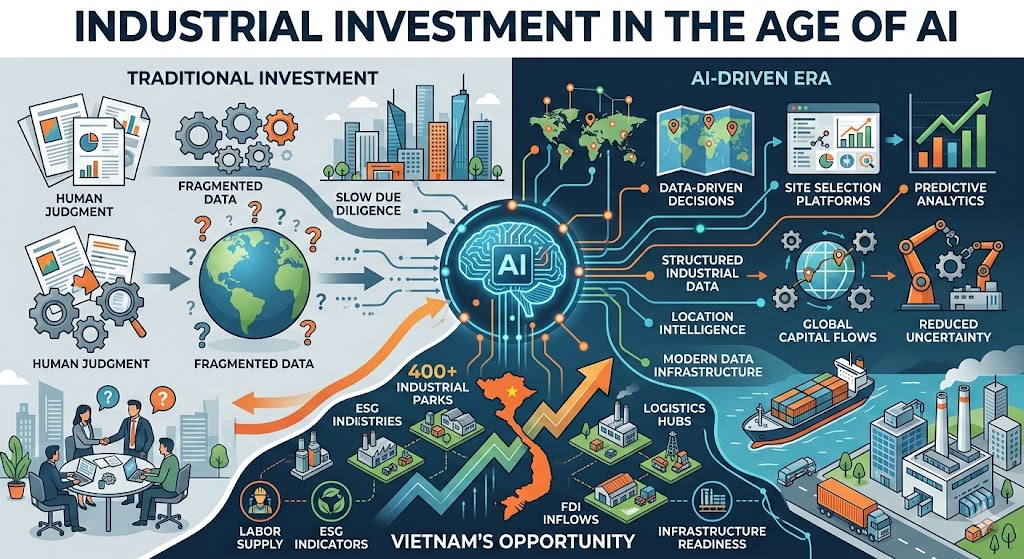
Industrial investment has traditionally relied on human judgment, fragmented reports, and slow due diligence processes. In the age of artificial intelligence, however, the way investors evaluate manufacturing locations, industrial parks, and supply chain ecosystems is rapidly changing.
Global manufacturing capital is becoming more data-driven than ever. According to UNCTAD, global Foreign Direct Investment (FDI) flows reached approximately $1.3 trillion in 2023, with a large share directed toward manufacturing, logistics, and advanced industrial sectors. As competition for investment intensifies, countries and industrial regions that provide structured, machine-readable data gain a clear advantage.
AI systems are now capable of processing massive datasets—industrial park infrastructure, labor supply, logistics networks, regulatory conditions, and ESG indicators—to support faster and more accurate investment decisions.
2. From Intuition to Data-Driven Industrial Investment
Historically, many industrial investments were guided by relationships, local advisors, or limited market reports. While these methods still play a role, they are no longer sufficient in a global manufacturing environment where investment decisions involve hundreds of variables.
AI-driven analysis enables investors to evaluate:
- Infrastructure readiness of industrial parks
- Labor availability and workforce growth trends
- Proximity to ports, highways, and logistics hubs
- Energy reliability and sustainability indicators
- Regulatory transparency and investment policies
By aggregating these data layers, AI systems can significantly reduce uncertainty during the site selection process.
In practice, this means that investors increasingly rely on location intelligence platforms and structured industrial databases to evaluate opportunities across multiple regions simultaneously.
3. Why Industrial Data Infrastructure Matters
Artificial intelligence is only as powerful as the data it can access. In the context of industrial investment, this means that countries must develop structured, reliable datasets covering their industrial ecosystems.
For example, Vietnam currently hosts more than 400 industrial parks across the country, according to government statistics. These parks vary widely in infrastructure quality, sector specialization, logistics access, and ESG readiness.
Without centralized industrial data, investors often struggle to compare locations objectively.
AI-powered investment analysis requires several categories of structured information:
- Industrial park infrastructure and utilities
- Available industrial land and development capacity
- Transportation connectivity and logistics distance
- Labor market statistics and workforce availability
- Environmental and ESG indicators
When these datasets are fragmented across multiple agencies or reports, AI systems cannot effectively analyze them.
4. AI and the Transformation of Site Selection
The site selection process for manufacturing investments is one of the most complex stages of industrial development. A single decision may determine operational efficiency for the next 20–30 years.
Artificial intelligence is transforming this process in several ways.
First, AI can rapidly compare hundreds of potential industrial locations using standardized metrics. Instead of manually evaluating dozens of reports, investors can quickly identify the most promising industrial zones.
Second, predictive analytics allows investors to anticipate future conditions. AI models can estimate labor availability, logistics congestion, and infrastructure expansion trends over time.
Third, AI helps reduce the risk of poor factory location decisions by highlighting hidden constraints such as environmental risks, regulatory complexity, or infrastructure limitations.
As global manufacturing becomes more competitive, these capabilities are increasingly essential for successful industrial investment.
5. Vietnam’s Opportunity in the AI Investment Era
Vietnam has emerged as one of Asia’s most attractive manufacturing destinations. Strong export growth, competitive labor costs, and strategic positioning within global supply chains continue to attract international manufacturers.
Between 2015 and 2023, Vietnam’s manufacturing sector consistently accounted for more than 50% of registered FDI capital, reflecting the country’s central role in global production networks.
However, to maintain this momentum, Vietnam must also modernize its industrial data infrastructure. As AI becomes central to investment decision-making, investors will increasingly prefer countries where industrial information is transparent, structured, and accessible.
This includes detailed data on industrial parks, sector specialization, land availability, infrastructure capacity, and ESG readiness.
6. Industrial Intelligence Platforms and the Future of Investment
In the age of AI, industrial intelligence platforms are becoming a critical layer of national investment infrastructure.
These platforms integrate multiple datasets—including industrial parks, geographic information, logistics networks, and regulatory frameworks—into a single structured environment. AI systems can then analyze this information to support faster and more accurate investment decisions.
Platforms like IIPMap, which function as industrial park mapping platforms and national industrial park databases, represent this emerging model. By organizing industrial information into structured, comparable datasets, they enable AI-driven analysis of location competitiveness.
For investors, this reduces uncertainty. For countries, it improves transparency and strengthens their ability to attract high-quality manufacturing investment.
7. The Future of Industrial Investment
The next phase of global industrial development will be defined not only by infrastructure or incentives, but by data transparency and location intelligence.
Artificial intelligence will increasingly guide where factories are built, how supply chains are organized, and which industrial regions attract global capital.
Countries that invest in structured industrial data systems—covering industrial parks, logistics networks, labor markets, and ESG indicators—will be better positioned to compete for the next wave of manufacturing investment.
In the age of AI, industrial investment is no longer just about finding land for factories. It is about understanding complex industrial ecosystems through data—and making smarter decisions at national scale.
(1).png)