Industrial Platforms as National Infrastructure
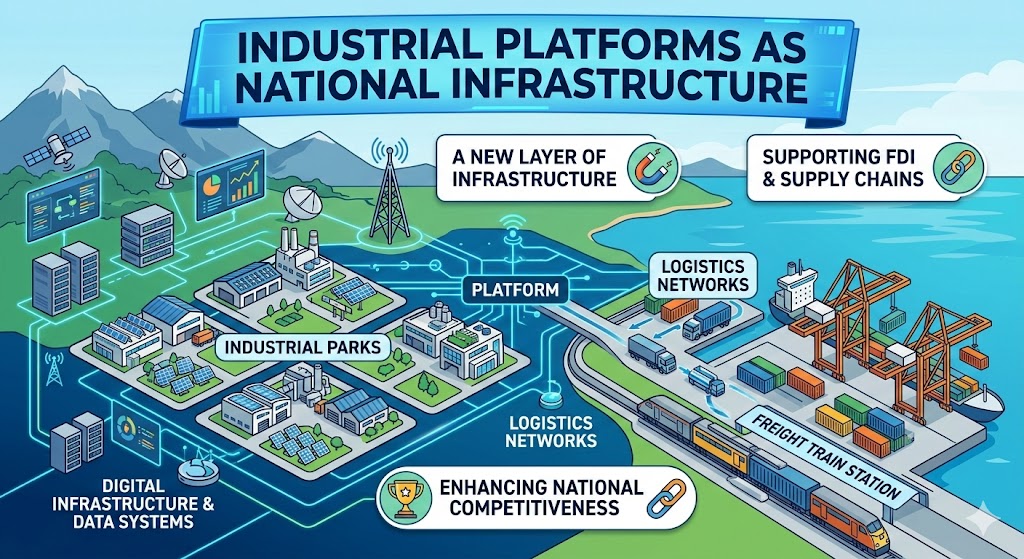
Industrial platforms are emerging as a new form of national infrastructure, supporting manufacturing investment, strengthening supply chains, and attracting global FDI through integrated industrial ecosystems.
Industrial Platforms as National Infrastructure
1. A New Layer of Economic Infrastructure
For decades, national infrastructure was understood mainly through physical assets such as highways, ports, airports, and power grids. These systems enabled trade, transportation, and industrial growth. Today, however, a new layer of infrastructure is becoming equally important: industrial platforms.
Industrial platforms combine physical industrial parks, logistics networks, digital infrastructure, and data systems into a coordinated ecosystem that supports manufacturing investment. According to the World Bank, manufacturing and industrial activities account for roughly 16–17% of global GDP, while global supply chains involve production networks spanning dozens of countries. In such an interconnected economy, efficient industrial platforms function much like national infrastructure—supporting economic activity at scale.
Countries that successfully build these platforms tend to attract more foreign direct investment (FDI), strengthen supply chains, and accelerate industrial development.
2. Industrial Parks as Strategic Economic Assets
Industrial parks have evolved far beyond simple clusters of factories. In many countries, they now function as strategic economic infrastructure designed to support large-scale manufacturing.
For example, data from the United Nations Conference on Trade and Development indicates that over 6,000 industrial parks and special economic zones operate globally, hosting thousands of manufacturing companies and millions of workers. These zones help concentrate infrastructure investment, streamline administrative procedures, and create industrial ecosystems that attract global manufacturers.
In rapidly industrializing economies, industrial parks often account for a significant share of exports and foreign investment. Their role is comparable to major transportation hubs or logistics corridors within national economic systems.
3. Supporting Foreign Direct Investment
Industrial platforms play a critical role in facilitating foreign direct investment. Multinational manufacturers typically look for locations where infrastructure, regulatory processes, and logistics services are already integrated.
According to the Organisation for Economic Co-operation and Development, countries with well-developed industrial zones attract significantly higher manufacturing FDI, particularly in sectors such as electronics, automotive components, and machinery production.
Industrial platforms reduce the barriers that foreign investors often face when entering new markets. Instead of building infrastructure from scratch, companies can access ready-built facilities, utilities, and supply chain networks within an established industrial ecosystem.
This efficiency shortens investment timelines and lowers the overall risk of manufacturing projects.
4. Strengthening National Supply Chains
Industrial platforms also strengthen national supply chains by encouraging the clustering of related industries. When manufacturers, suppliers, logistics providers, and service companies operate in close proximity, production becomes more efficient and resilient.
Research from the McKinsey & Company shows that companies located within industrial clusters can reduce logistics costs by 15–25% and improve supply chain efficiency significantly. These advantages are particularly important for export-oriented industries that rely on global production networks.
By organizing industries into coordinated platforms, governments can create environments where manufacturing ecosystems grow naturally over time.
5. Integrating Digital Infrastructure with Industrial Development
Modern industrial platforms are increasingly built on digital infrastructure. Data systems, smart logistics technologies, and digital supply chain management tools are becoming essential components of industrial development.
Industry studies estimate that more than 70% of manufacturing companies now use advanced data analytics in supply chain planning. Digital platforms allow manufacturers to monitor production, track logistics flows, and coordinate suppliers in real time.
When industrial parks integrate digital systems with physical infrastructure, they become far more attractive to global investors seeking efficient and technologically advanced production environments.
6. Enhancing National Competitiveness
Countries compete globally to attract manufacturing investment. Industrial platforms provide a strategic advantage by creating highly efficient environments for production and logistics.
For instance, the rapid industrial growth of countries in East and Southeast Asia has been closely linked to the development of industrial parks and export processing zones. These platforms help concentrate infrastructure spending, improve regulatory efficiency, and support industrial clustering.
By functioning as coordinated ecosystems rather than isolated industrial sites, industrial platforms contribute directly to national economic competitiveness.
7. Industrial Platforms as the Future of Economic Development
As global manufacturing becomes more complex and interconnected, the importance of industrial platforms will continue to grow. Governments increasingly recognize that developing these platforms is not simply an industrial policy—it is a form of national infrastructure investment.
Just as highways enable transportation and ports facilitate trade, industrial platforms enable large-scale manufacturing and global supply chain integration. Countries that invest strategically in these systems will be better positioned to attract high-value manufacturing, expand exports, and strengthen long-term economic growth.
In this sense, industrial platforms are no longer just real estate developments. They are becoming essential infrastructure for the modern industrial economy.
(1).png)