Industry-Specific Location Strategy for FDI
Industry-specific location strategies help foreign investors match manufacturing needs with infrastructure, labor, and supply chains. This targeted approach improves efficiency and reduces risks in FDI site selection.
Industry-Specific Location Strategy for FDI
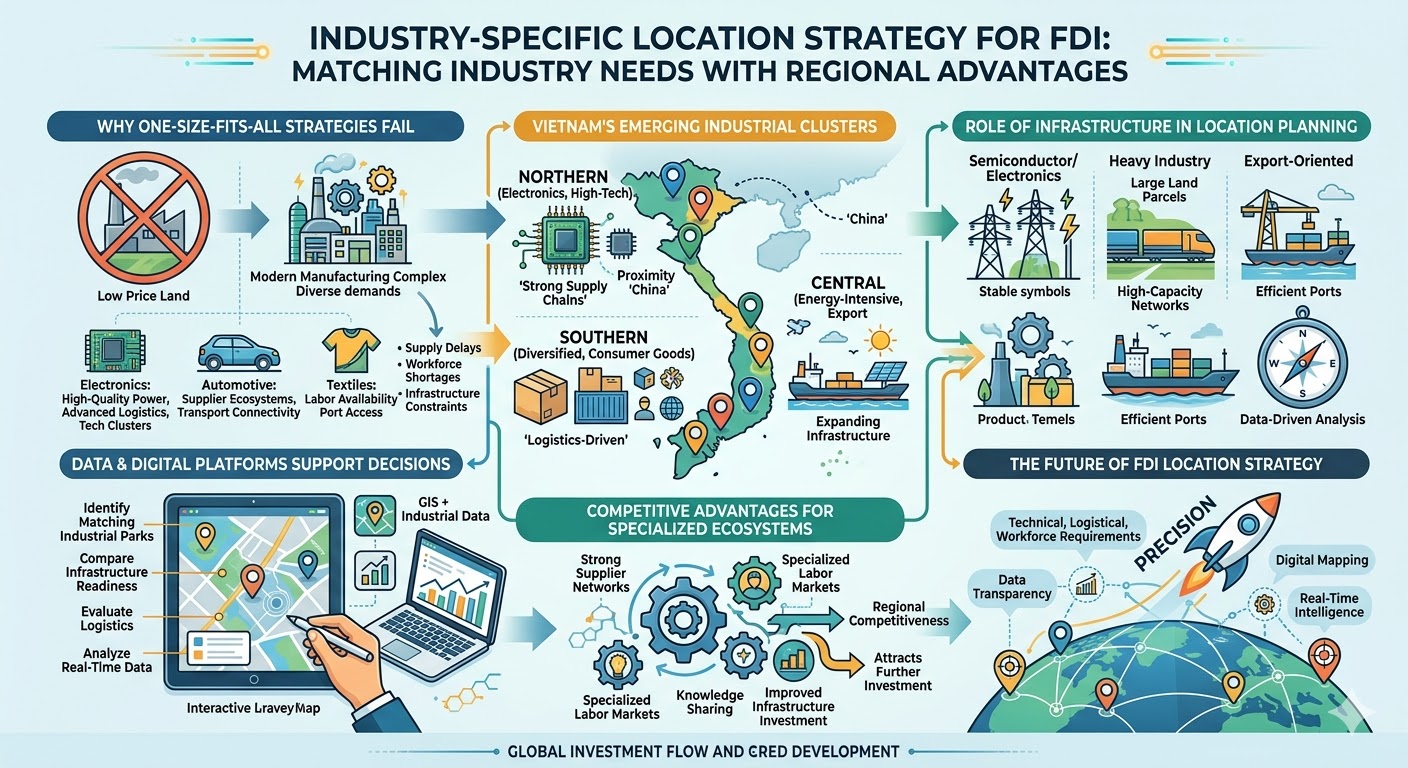
Foreign direct investment (FDI) decisions are no longer based solely on land price or basic infrastructure. As global supply chains become more specialized and competitive, investors increasingly adopt industry-specific location strategies when selecting manufacturing sites.
Different industries require different ecosystems. Electronics manufacturers depend on semiconductor supply chains and skilled technicians, while textile companies prioritize labor availability and export logistics. As a result, identifying the right location is not simply about finding available land—it is about aligning industry requirements with regional advantages.
This shift is transforming how investors evaluate industrial parks and manufacturing hubs.
1. Why One-Size-Fits-All Location Strategies No Longer Work
Historically, many industrial parks marketed themselves as suitable for all industries. However, the reality of modern manufacturing is far more complex. Each sector has unique operational requirements that directly affect productivity and cost efficiency.
For example: Electronics manufacturing requires high-quality power supply, advanced logistics, and proximity to technology clusters.
Automotive manufacturing depends on supplier ecosystems and transport connectivity. Textile and garment industries prioritize labor availability and export port access. When these requirements are not aligned with location advantages, operational inefficiencies quickly emerge. Factories may face supply delays, workforce shortages, or infrastructure constraints.
Therefore, investors increasingly prioritize industry-aligned industrial zones rather than generic manufacturing locations.
2. Vietnam’s Emerging Industrial Clusters
Vietnam has gradually developed several regional industrial clusters that naturally support different sectors. These clusters are becoming key considerations for foreign investors planning long-term manufacturing operations.
For instance: Northern Vietnam has become a hub for electronics and high-tech manufacturing, supported by strong supply chains and proximity to China. Southern Vietnam hosts diversified manufacturing sectors including consumer goods, electronics, and logistics-driven industries. Central Vietnam is emerging as a location for energy-intensive industries and export manufacturing due to expanding port infrastructure.
This clustering effect helps companies reduce logistics costs, access suppliers more efficiently, and benefit from knowledge spillovers within industry ecosystems.
3. The Role of Infrastructure in Industry-Specific Location Planning
Infrastructure compatibility plays a critical role in industry-specific site selection. Certain industries demand infrastructure that goes beyond basic utilities. For example:
- Semiconductor and electronics factories require stable power supply and advanced utilities.
- Heavy industries require large land parcels and high-capacity transport networks.
- Export-oriented sectors require efficient port and logistics connectivity.
Without careful location analysis, investors risk selecting sites that cannot fully support their production scale or technology requirements.
Modern industrial location planning therefore requires data-driven infrastructure analysis, including transportation networks, power capacity, and logistics accessibility.
4. Data and Digital Platforms Supporting Industry-Specific Decisions
As industrial location decisions become more complex, investors increasingly rely on digital intelligence platforms to analyze industrial land availability alongside infrastructure and economic data.
These platforms allow investors to:
- Identify industrial parks that match their industry requirements
- Compare infrastructure readiness across regions
- Evaluate logistics accessibility and supplier ecosystems
- Analyze occupancy rates and land availability in real time
By combining geographic information systems (GIS) with industrial data, investors can quickly narrow down locations that align with their sector-specific needs.
This approach significantly reduces the time and uncertainty associated with traditional site selection processes.
5. Competitive Advantages for Regions with Specialized Industrial Ecosystems
Regions that successfully attract specific industries often develop strong competitive advantages over time. As supply chains concentrate geographically, the benefits multiply for both investors and local economies.
Industry-focused clusters can generate:
- Strong supplier networks
- Specialized labor markets
- Knowledge sharing between companies
- Improved infrastructure investment
These advantages create a self-reinforcing ecosystem that attracts further investment.
For governments and industrial park developers, encouraging sector-focused industrial development can be a powerful strategy to enhance regional competitiveness.
6. The Future of FDI Location Strategy
The next phase of industrial investment will be increasingly driven by precision in location strategy. Instead of evaluating hundreds of generic industrial sites, investors will focus on locations that match the technical, logistical, and workforce requirements of their industry.
Data transparency, digital mapping platforms, and real-time industrial intelligence will play a central role in this transformation.
Industry-specific location strategies will not only help investors reduce operational risk but also support the development of more efficient and specialized industrial ecosystems. As global manufacturing continues to evolve, the ability to match industry needs with the right geographic location will become one of the most important factors shaping the future of foreign direct investment.
(1).png)