Lessons from Failed Factory Location Decisions
Failed factory location decisions can create long-term operational challenges for manufacturers. This article explores key lessons from unsuccessful factory sites and highlights the importance of infrastructure, labor, logistics, and strategic location analysis.
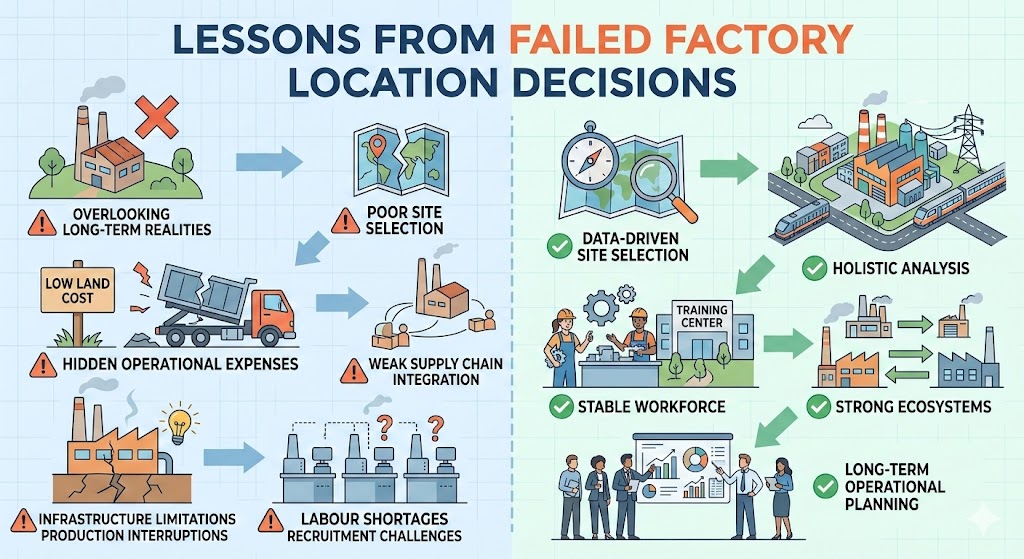
Lessons from Failed Factory Location Decisions
1. When a Strategic Decision Becomes a Costly Mistake
Choosing where to build a factory is one of the most consequential decisions a manufacturing company can make. A well-chosen location can unlock supply chain efficiency, reduce logistics costs, and ensure stable production for decades. A poorly chosen one, however, can create operational bottlenecks that are difficult—and expensive—to fix.
Across many industries, failed factory location decisions often share a common pattern: investors focus too heavily on short-term cost advantages while overlooking long-term operational realities. Cheap land or attractive tax incentives may appear compelling at the beginning, but they rarely compensate for structural weaknesses in infrastructure, labor availability, or logistics connectivity.
2. The Illusion of Low Land Costs
One of the most frequent mistakes investors make is prioritizing low industrial land prices without carefully evaluating the surrounding ecosystem. While land cost is an important component of initial investment, it represents only a small portion of a factory’s lifetime operating expenses.
Factories located in remote or underdeveloped areas often face higher transportation costs, longer delivery times, and limited access to suppliers. These hidden costs accumulate over time and can significantly reduce the competitiveness of a manufacturing operation.
In many cases, companies later discover that paying more for land in a well-developed industrial zone would have produced far greater operational efficiency.
3. Underestimating Infrastructure Limitations
Infrastructure is the backbone of manufacturing operations, yet it is frequently underestimated during site selection. Reliable electricity supply, efficient transportation networks, wastewater treatment systems, and logistics infrastructure all directly affect factory productivity.
When infrastructure is insufficient, production interruptions become more common. Delays in raw material delivery, unstable power supply, or inadequate road access can slow down operations and increase operational risk.
Many failed factory locations share this characteristic: the physical infrastructure simply cannot support the scale and complexity of modern manufacturing.
4. Ignoring Labor Market Realities
Another major lesson from unsuccessful factory locations involves labor availability. Manufacturing facilities require a stable workforce, both in terms of quantity and skill level. When factories are built in regions with limited labor supply or inadequate training institutions, recruitment becomes a persistent challenge.
Companies may then be forced to invest heavily in worker relocation, transportation, or training programs. These additional costs can quickly erode the financial advantages that initially attracted investors to the location.
Successful factory locations, by contrast, are often situated near population centers, technical schools, or established industrial clusters where skilled workers are readily available.
5. Weak Supply Chain Integration
Modern manufacturing rarely operates in isolation. Most factories depend on a network of suppliers, logistics providers, and distribution channels that must function smoothly to maintain production efficiency.
When a factory is placed far from key suppliers or logistics hubs, the supply chain becomes longer and more fragile. Transportation delays, increased inventory requirements, and higher logistics costs are common consequences.
In contrast, factories located within established industrial ecosystems benefit from shorter supply chains and stronger collaboration with nearby partners.
6. Overlooking Regulatory and Administrative Complexity
Regulatory environments can also determine whether a factory location succeeds or struggles. In some cases, investors underestimate the complexity of local administrative procedures, land regulations, or environmental compliance requirements.
Unexpected regulatory delays can slow down construction, disrupt production planning, or increase compliance costs. For multinational companies, regulatory uncertainty can create additional risks that affect long-term investment strategies.
Industrial parks and regions that offer transparent policies, clear land-use regulations, and streamlined licensing procedures tend to attract more stable manufacturing investment.
7. Turning Failure into Strategic Insight
Despite the challenges associated with failed factory location decisions, these experiences often provide valuable lessons for future investments. Companies increasingly recognize the importance of data-driven site selection, comprehensive location analysis, and long-term operational planning.
Instead of focusing solely on upfront costs, investors now evaluate broader factors such as infrastructure readiness, labor market dynamics, logistics networks, and regulatory transparency. This more holistic approach helps reduce uncertainty and improve the long-term success of manufacturing investments.
Ultimately, the lessons from failed factory locations highlight a simple truth: successful manufacturing depends not only on technology or capital, but also on choosing the right place to build.
(1).png)