The Benefits of Real-Time Occupancy Tracking in Industrial Parks.
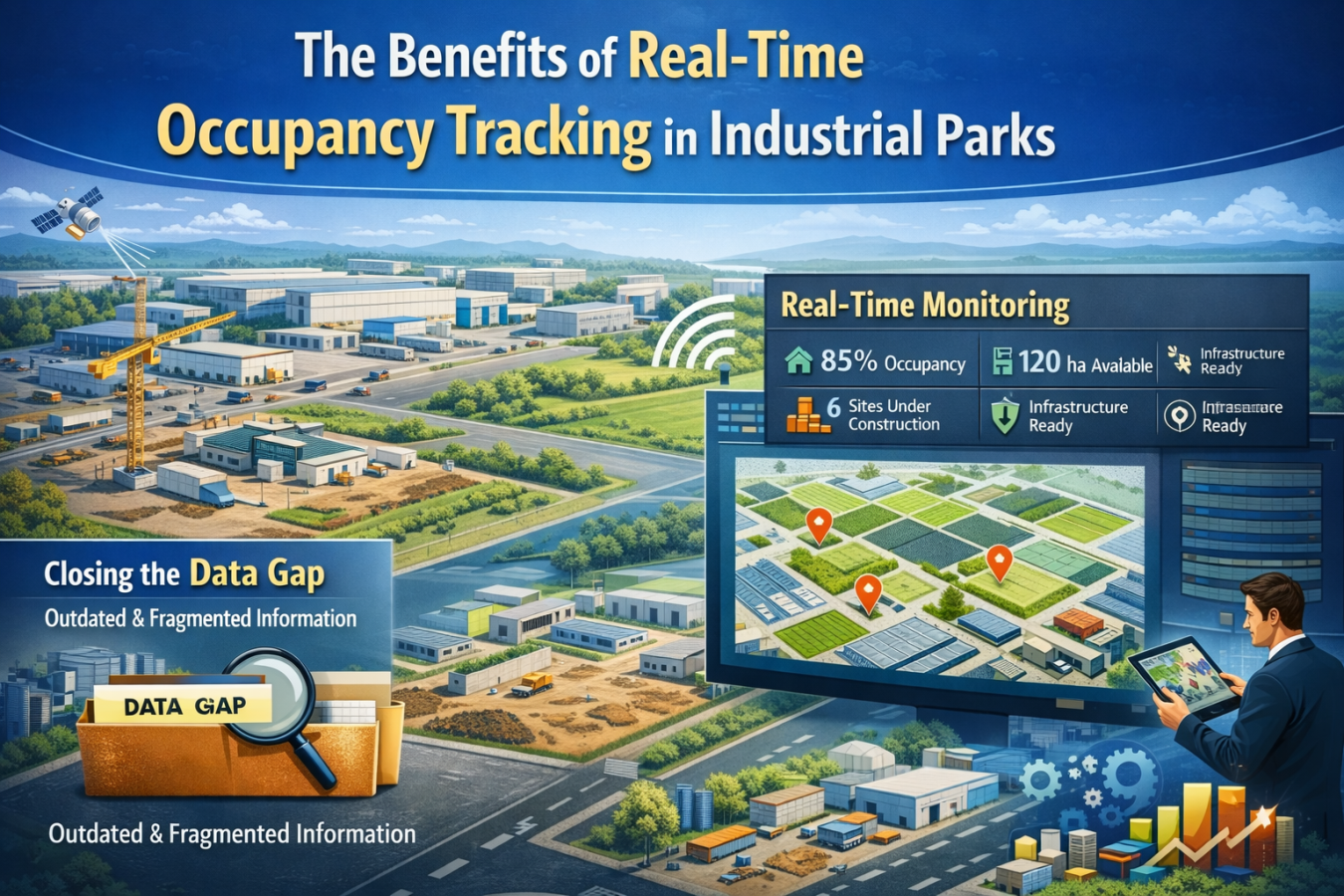
Real-time occupancy tracking helps industrial parks improve transparency, monitor land utilization, and support faster investment decisions by providing accurate data on factory occupancy and land availability.
The Benefits of Real-Time Occupancy Tracking in Industrial Parks
1. The Data Gap in Industrial Park Management
Industrial parks are central to modern manufacturing ecosystems, hosting thousands of factories that contribute to exports, employment, and regional economic growth. Globally, the number of industrial parks has expanded rapidly as countries compete to attract manufacturing investment.
However, despite this expansion, many industrial parks still lack real-time visibility into occupancy levels, land availability, and development progress. Information about available land is often outdated, scattered across multiple sources, or dependent on manual reporting.
This data gap creates inefficiencies for both investors and developers. Companies searching for factory locations may spend months verifying land availability, while industrial park operators struggle to monitor capacity utilization accurately.
Real-time occupancy tracking is emerging as a critical solution to improve transparency and operational efficiency in industrial parks.
2. Understanding Real-Time Occupancy Tracking
Real-time occupancy tracking refers to digital systems that continuously update information about land use, factory occupancy, and development status within industrial parks. Instead of relying on periodic reports, these systems integrate multiple data sources to provide up-to-date insights.
Typical data tracked in real time includes:
- Total industrial land area
- Occupied and available land parcels
- Factories under construction
- Infrastructure readiness
- Utility capacity utilization
Through digital dashboards or GIS platforms, investors and developers can instantly view the current status of industrial park capacity.
3. Improving Transparency for Investors
One of the biggest challenges in industrial real estate markets is the lack of transparency. Investors often rely on brokers or local contacts to identify available land, which may lead to incomplete or outdated information.
Real-time occupancy tracking significantly improves transparency by providing accurate and continuously updated data on industrial park capacity.
For example, if an industrial park reports an occupancy rate of 85–90%, investors immediately understand that land availability is limited and that competition for remaining plots may be intense. Conversely, parks with lower occupancy rates may offer larger development opportunities.
Access to real-time data enables investors to compare industrial parks more effectively and make faster site selection decisions.
4. Supporting More Efficient Land Utilization
Industrial land is a scarce and valuable resource, particularly in rapidly industrializing regions. Without accurate occupancy tracking, large areas of industrial land may remain underutilized due to inefficient planning or outdated information.
Real-time tracking systems allow industrial park managers to monitor land usage more precisely. They can quickly identify unused plots, delayed projects, or areas where infrastructure development has stalled.
This improved visibility helps ensure that industrial land is allocated more efficiently, supporting higher occupancy rates and more productive industrial ecosystems.
5. Accelerating Investment Decisions
Manufacturing investments often involve complex planning and tight timelines. Companies expanding production capacity need to identify suitable locations quickly to maintain supply chain competitiveness.
Real-time occupancy data shortens the site selection process by allowing investors to instantly identify available locations within industrial parks. Instead of conducting lengthy manual searches, companies can evaluate multiple options simultaneously using digital platforms.
Faster access to reliable information helps reduce the time required for location analysis and accelerates the overall investment process.
6. Enhancing Strategic Planning for Developers
Industrial park developers also benefit significantly from real-time occupancy tracking. By monitoring land utilization and factory activity continuously, developers gain deeper insights into market demand and investment trends.
For instance, if occupancy rates in certain regions exceed 90%, developers may consider expanding existing parks or planning new industrial zones nearby. Conversely, areas with slower occupancy growth may require infrastructure upgrades or policy adjustments to attract investment.
Real-time data enables developers to make more informed strategic decisions about industrial park expansion and infrastructure investment.
7. Building a Data-Driven Industrial Ecosystem
The future of industrial development increasingly depends on data transparency and digital infrastructure. Real-time occupancy tracking represents an important step toward building a more intelligent industrial ecosystem.
When integrated with broader industrial intelligence platforms—such as GIS-based mapping systems and economic data tools—occupancy tracking can provide deeper insights into industrial clusters, supply chain dynamics, and regional competitiveness.
For investors, developers, and policymakers alike, access to reliable and real-time industrial data will become a decisive factor in shaping the next generation of manufacturing investment.
(1).png)