The End of Guesswork in Factory Location Decisions
Say goodbye to guesswork in factory site selection. AI and data-driven location intelligence help investors make informed, cost-effective, and sustainable industrial decisions.
The End of Guesswork in Factory Location Decisions
1. Moving Beyond Intuition
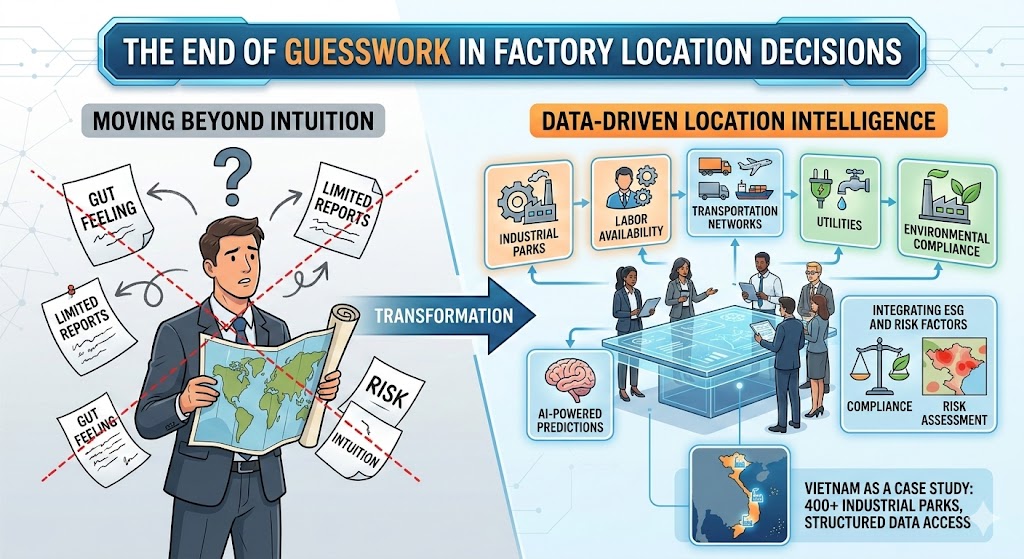
For decades, factory location decisions were often guided by intuition, personal networks, or limited reports. Companies relied on local advisors, sporadic data, or even gut feeling to choose where to invest—a process fraught with risk. A single misjudgment could lead to higher costs, supply chain inefficiencies, or long-term operational headaches.
Today, the landscape is shifting. With the rise of data analytics, location intelligence, and AI-powered tools, businesses no longer need to rely on guesswork. Investors can now make informed decisions by evaluating multiple variables simultaneously, from logistics access to labor market trends.
2. The Cost of Wrong Decisions
Choosing the wrong factory location carries tangible consequences. According to the World Bank, companies that underestimated infrastructure or logistics challenges can see operational costs rise by 15–20% annually. Poor site selection also leads to delays in production, missed deadlines, and reduced competitiveness in global markets.
Historical examples abound. Many foreign manufacturers entering Southeast Asia initially ignored critical factors such as energy reliability or regulatory transparency, only to face costly relocations or production halts. These cases underscore the necessity of systematic, data-driven analysis.
3. Data-Driven Location Intelligence
The modern approach leverages structured datasets covering industrial parks, labor availability, transportation networks, utilities, and environmental compliance. Advanced analytics platforms consolidate this information, enabling investors to compare multiple locations objectively.
Artificial intelligence can even forecast future conditions, such as infrastructure expansion or labor market shifts, reducing uncertainty in long-term planning. By turning complex variables into actionable insights, AI replaces guesswork with precision.
4. Integrating ESG and Risk Factors
Site selection today also requires considering environmental, social, and governance (ESG) factors. Investors need to assess regulatory compliance, pollution risks, community impact, and sustainability metrics. AI-driven platforms can quickly highlight potential constraints and opportunities, ensuring factories are not only profitable but also socially responsible.
5. Vietnam as a Case Study
Vietnam offers a compelling example of this transformation. With over 400 industrial parks and a rapidly growing manufacturing sector, companies now have access to structured data and analytical tools to evaluate locations efficiently. AI-enabled platforms allow investors to benchmark sites on infrastructure quality, labor costs, logistics connectivity, and ESG readiness, making the process faster, cheaper, and more reliable.
6. The Future of Site Selection
The next era of industrial investment will leave guesswork behind. Companies that adopt data-driven, AI-powered location strategies will gain a competitive advantage, optimizing costs, operational efficiency, and sustainability. Meanwhile, nations that provide transparent, structured industrial information will attract higher-quality foreign direct investment.
7. Conclusion
Factory location decisions are no longer a gamble. The combination of big data, AI, and location intelligence empowers investors to make precise, informed choices. By leveraging these tools, businesses can minimize risk, maximize efficiency, and thrive in an increasingly competitive global market.
(1).png)