The Future of Site Selection: Predictive Analytics on IIPMap
Predictive analytics is transforming industrial site selection in Vietnam. Discover how IIPMap uses data intelligence and GIS to identify emerging industrial zones and support smarter investment decisions.
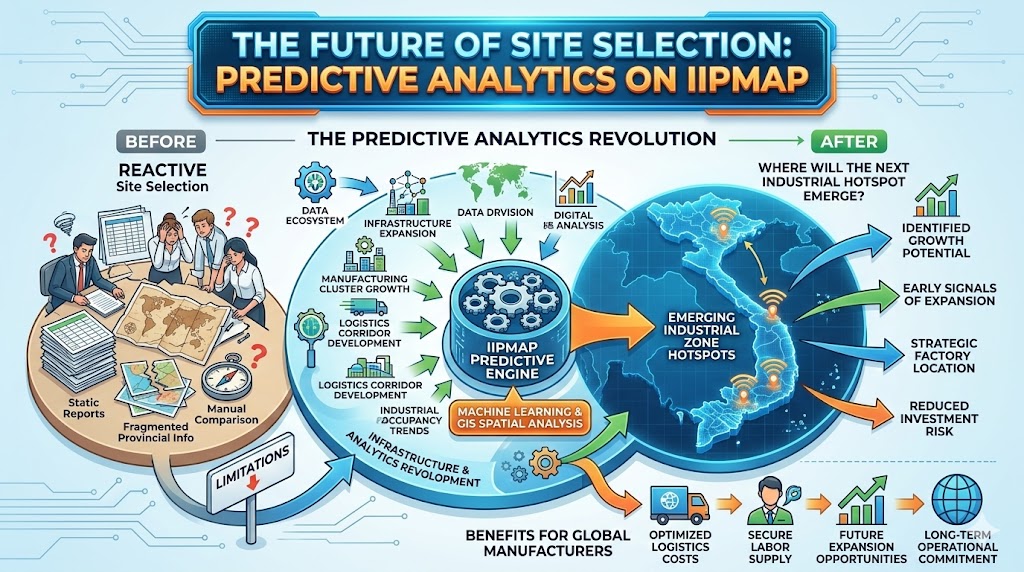
The Future of Site Selection: Predictive Analytics on IIPMap
Vietnam’s industrial landscape is expanding rapidly as global manufacturers continue to relocate supply chains into Southeast Asia. Yet the process of choosing the right industrial location remains one of the most complex decisions investors face. Traditional site selection methods—relying on spreadsheets, static reports, and brokerage networks—often fail to capture the dynamic nature of today’s industrial market.
This is where predictive analytics begins to reshape how industrial land is evaluated. By combining large-scale industrial datasets with machine learning and GIS-based spatial analysis, platforms like IIPMap.com introduce a new approach to site selection: anticipating industrial growth rather than simply reacting to current conditions.
Instead of asking “Where is land available today?”, investors can now ask a more strategic question:
“Where will the next industrial hotspot emerge?”
1. From Static Site Selection to Predictive Location Strategy
For decades, industrial site selection has been reactive. Investors identify existing industrial parks, compare infrastructure access, review incentives, and negotiate land availability. While effective in the past, this model struggles in markets where industrial supply and demand shift rapidly.
Predictive analytics introduces a forward-looking model. By analyzing patterns such as:
- Infrastructure expansion
- Manufacturing cluster growth
- Logistics corridor development
- Industrial park occupancy trends data platforms can begin identifying areas likely to experience future industrial growth.
This transition marks a fundamental shift from site selection based on current listings to site selection based on future potential.
2. The Data Foundation Behind Predictive Industrial Insights
Predictive analytics requires a strong data infrastructure. Industrial real estate platforms must integrate multiple layers of information to generate meaningful forecasts.
Key data sources include:
- Industrial park occupancy rates
- Provincial industrial planning data
- Transportation infrastructure networks
- Logistics connectivity to ports and airports
- Regional manufacturing concentration
Vietnam currently hosts more than 400 industrial parks covering roughly 120,000 hectares of land, according to the Ministry of Planning and Investment. However, this information is scattered across provinces, park developers, and government portals, making comprehensive analysis difficult.
Platforms like IIPMap.com address this fragmentation by centralizing industrial datasets into a unified digital intelligence layer, enabling advanced analytics.
3. How Predictive Analytics Identifies Emerging Industrial Zones
Once industrial datasets are centralized, predictive algorithms can analyze patterns that indicate future growth. Several signals often precede industrial expansion:
- Infrastructure acceleration: New expressways, ports, and logistics hubs significantly increase industrial land demand in nearby regions.
- Manufacturing clustering effects: Suppliers tend to locate near existing production hubs to reduce logistics costs and strengthen supply chain integration.
- Industrial park expansion phases: When existing parks reach high occupancy rates, surrounding districts frequently experience rapid industrial development.
Predictive analytics can detect these signals earlier than traditional market reports, helping investors identify emerging industrial corridors before land prices rise.
4. Visualizing Industrial Growth Through GIS Intelligence
Data becomes significantly more powerful when combined with geographic visualization tools.
GIS platforms transform complex industrial datasets into interactive maps that reveal spatial patterns instantly. Investors can visualize relationships between:
- Industrial parks and highway corridors
- Manufacturing clusters and logistics hubs
- Infrastructure investment and land availability
For example, Vietnam’s Northern Economic Corridor, connecting Hanoi, Bac Ninh, Hai Phong, and Quang Ninh, has become one of the country’s most important industrial zones due to its proximity to major ports and export infrastructure.
By mapping such corridors, GIS platforms allow investors to analyze industrial ecosystems rather than isolated locations.
5. IIPMap and the Rise of Predictive Industrial Intelligence
IIPMap.com represents a new generation of industrial data platforms designed to support predictive site selection. Rather than functioning solely as an industrial park directory, the platform integrates:
- Centralized industrial park databases
- Infrastructure proximity mapping
- Spatial analytics tools
- Cross-referenced land availability data
This combination enables investors to analyze industrial locations from multiple strategic angles simultaneously.
Instead of reviewing disconnected datasets, decision-makers gain access to a unified industrial intelligence system capable of supporting predictive insights.
6. Why Predictive Site Selection Matters for Global Manufacturers
Manufacturing investment decisions often involve hundreds of millions of dollars in capital expenditure and long-term operational commitments. Selecting the wrong location can lead to higher logistics costs, labor shortages, and limited expansion opportunities.
Predictive analytics reduces these risks by enabling investors to evaluate:
- Future infrastructure connectivity
- Long-term regional growth potential
- Emerging industrial clusters
- Competitive land availability trends
This forward-looking approach helps companies secure locations before demand intensifies and industrial land prices escalate.
7. The Next Evolution of Industrial Location Intelligence
Industrial site selection is entering a new era driven by data science, machine learning, and spatial intelligence. As industrial ecosystems become more complex, decision-making tools must evolve beyond traditional brokerage-driven research.
Predictive analytics represents the next frontier in industrial real estate, transforming location analysis from a manual process into a data-powered strategic capability.
Platforms like IIPMap.com illustrate how this transformation is unfolding in Vietnam—bridging fragmented industrial data and enabling investors to navigate the market with greater speed, clarity, and foresight.
In the coming years, the question for industrial investors will no longer be whether to use predictive analytics, but how quickly they can integrate it into their site selection strategy.
(1).png)