The Next Decade of Industrial Development in Vietnam
Vietnam’s industrial sector is entering a new phase of growth. This article explores key trends shaping the next decade of industrial development, from high-tech manufacturing to sustainable industrial parks.
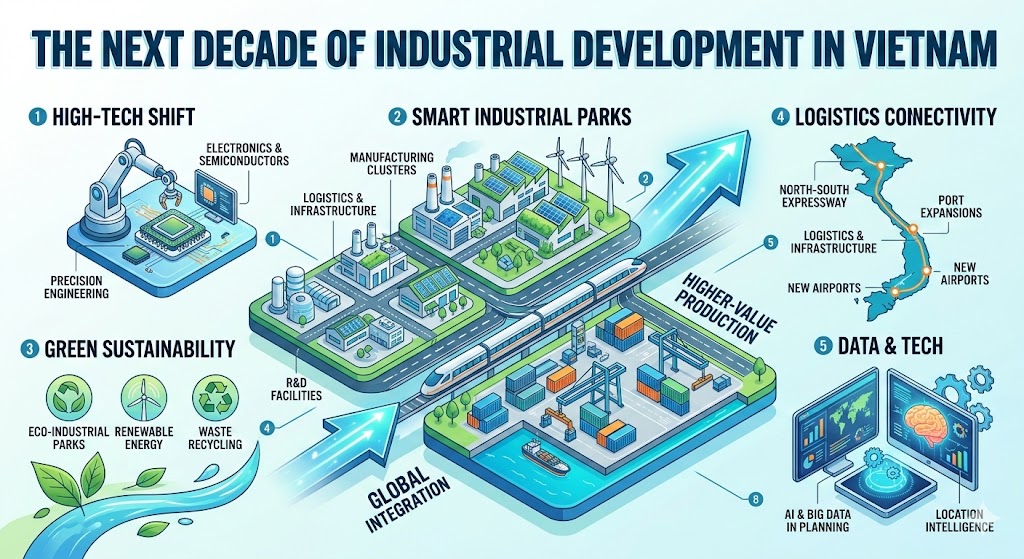
The Next Decade of Industrial Development in Vietnam
1. Vietnam at a New Industrial Turning Point
Over the past two decades, Vietnam has transformed from a largely agriculture-based economy into one of Asia’s most dynamic manufacturing hubs. According to the World Bank, the manufacturing sector now contributes more than 24–25% of Vietnam’s GDP, one of the highest proportions in Southeast Asia.
At the same time, foreign direct investment continues to accelerate industrial expansion. Data from the Ministry of Planning and Investment of Vietnam shows that FDI disbursement reached over $23 billion in 2023, with a large share flowing into manufacturing industries such as electronics, machinery, and high-tech components.
These trends suggest that the next decade will not simply be about expanding factories. It will be about redefining how industrial development is structured, planned, and integrated into the global economy.
2. From Low-Cost Manufacturing to Higher-Value Production
For many years, Vietnam’s competitive advantage came primarily from labor costs. However, the next phase of industrial development will increasingly focus on value creation rather than cost efficiency.
Manufacturers are gradually shifting toward:
- electronics and semiconductor supply chains
- precision engineering and industrial machinery
- renewable energy equipment
- advanced consumer electronics production
Vietnam already plays a major role in global electronics manufacturing. Companies such as Samsung Electronics have invested over $20 billion in Vietnam, making the country one of the company’s largest production bases worldwide. Over the next decade, similar investments in high-tech manufacturing could reshape Vietnam’s industrial structure.
3. Industrial Parks Becoming Integrated Economic Ecosystems
Vietnam currently hosts more than 400 industrial parks and economic zones, according to the Vietnam Ministry of Planning and Investment. Traditionally, many of these zones functioned mainly as land for factory construction.
The next generation of industrial development will look very different.
Industrial parks are expected to evolve into integrated ecosystems that combine:
- manufacturing clusters
- logistics infrastructure
- research and development facilities
- digital infrastructure
- worker housing and urban services
This shift reflects a broader trend across Asia, where industrial zones are becoming highly coordinated production environments rather than isolated factory sites.
4. Logistics Infrastructure Will Shape Industrial Expansion
Infrastructure development will strongly influence where and how industrial growth occurs in the coming decade.
Vietnam has already invested heavily in transportation projects, including:
- the North–South Expressway network
- major port expansions in cities such as Hai Phong and Ho Chi Minh City
- new international airport infrastructure such as Long Thanh International Airport
These investments aim to strengthen Vietnam’s position within global supply chains.
According to estimates from the Asian Development Bank, Vietnam needs over $480 billion in infrastructure investment by 2040 to maintain economic growth and support expanding industrial activity. Improved logistics connectivity will allow manufacturing clusters to develop beyond traditional industrial centers.
5. The Rise of Green and Sustainable Industrial Zones
Sustainability is becoming an increasingly important factor in industrial development. Global manufacturers now face pressure from investors, regulators, and consumers to meet environmental standards.
As a result, Vietnam is beginning to promote eco-industrial parks, which focus on: energy efficiency, renewable energy integration, industrial waste recycling, water resource management.
Programs supported by organizations such as the United Nations Industrial Development Organization have already introduced pilot eco-industrial parks in several provinces.
In the next decade, environmental performance will likely become a major factor influencing industrial investment decisions.
6. Regional Industrial Clusters Will Become More Specialized
Industrial development in Vietnam is also becoming increasingly regionalized.
Different regions are gradually forming specialized industrial clusters:
Northern Vietnam
• electronics and high-tech manufacturing
• semiconductor supply chains
• export-oriented industrial parks
Southern Vietnam
• consumer goods manufacturing
• logistics and port-based industries
• supporting industries for global supply chains
Central Vietnam
• heavy industry and energy-related manufacturing
• emerging logistics corridors
This specialization helps create stronger supply chain networks and encourages collaboration between manufacturers and suppliers.
7. Data, Technology, and AI Will Transform Industrial Planning
Industrial development strategies are also becoming more data-driven. Governments and investors are increasingly using advanced data systems to evaluate industrial land, logistics networks, and workforce availability.
Technologies such as: location intelligence, AI-based investment analysis, geospatial data platforms are helping decision-makers identify optimal locations for new manufacturing projects.
These tools allow investors to analyze hundreds of potential sites, predict infrastructure development patterns, and assess supply chain connectivity with far greater precision than traditional planning methods.
8. Vietnam’s Industrial Future
The next decade of industrial development in Vietnam will not simply involve building more factories. It will involve creating a more sophisticated industrial ecosystem—one that combines infrastructure, technology, sustainability, and global supply chain integration.
With strong FDI inflows, expanding logistics infrastructure, and a rapidly modernizing manufacturing sector, Vietnam is positioned to remain one of Asia’s most important industrial growth stories.
If current trends continue, the country could evolve from a regional manufacturing hub into a strategic center of global industrial production.
(1).png)