Using IIPMap to Cross-Reference Infrastructure with Land Availability
Using IIPMap, investors can cross-reference industrial land availability with infrastructure networks such as highways, ports, and power systems, enabling smarter and faster industrial site selection decisions.
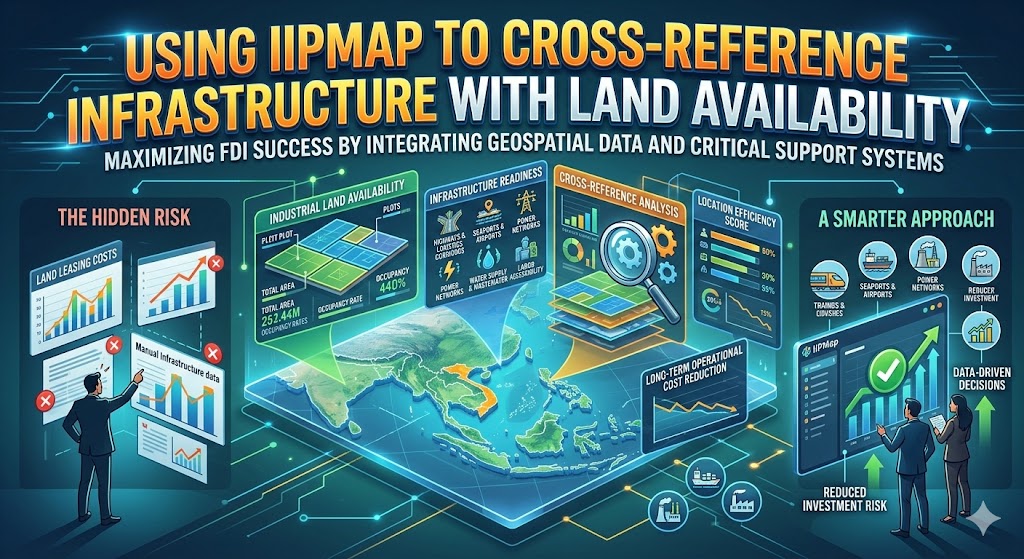
Using IIPMap to Cross-Reference Infrastructure with Land Availability
1. The Hidden Risk in Industrial Site Selection
For many manufacturing investors, selecting industrial land often begins with a simple question: Is land available? Yet availability alone rarely determines whether a factory location will succeed.
A plot of land may appear attractive because of low leasing costs or promotional incentives. However, if the surrounding infrastructure cannot support large-scale operations—such as reliable electricity supply, efficient transportation networks, or access to ports—the investment may face long-term operational challenges.
According to global logistics studies, transportation and infrastructure inefficiencies can increase operational costs by 10–25% for manufacturing companies. In emerging industrial markets, this risk is even higher when investors lack access to integrated infrastructure data.
This is why modern industrial investors increasingly focus on cross-referencing land availability with infrastructure readiness before making location decisions.
2. Why Infrastructure Matters as Much as Land
Industrial land is only one component of a functional manufacturing ecosystem. Factories depend on a wide range of supporting infrastructure, including:
- Highways and logistics corridors
- Seaports and airports
- Power generation and transmission networks
- Water supply and wastewater treatment
- Labor accessibility and urban connectivity
For example, industrial parks located within 50 km of major ports often reduce logistics costs by up to 20%, making them significantly more competitive for export-oriented manufacturing.
Without analyzing these infrastructure factors together with land availability, investors may select locations that look attractive initially but prove inefficient over time.
3. The Challenge of Fragmented Industrial Data
In many countries, industrial data is scattered across different sources. Information about industrial parks may come from developers, while infrastructure data is stored in transportation or energy planning documents. Labor statistics are often published separately by government agencies.
Because of this fragmentation, investors must manually combine multiple datasets to understand the full context of a location.
This process is time-consuming and prone to error. Investors may overlook critical infrastructure constraints or misinterpret regional development plans.
A centralized platform that integrates infrastructure and land data can significantly simplify this process.
4. How IIPMap Integrates Industrial and Infrastructure Data
IIPMap is designed to solve the problem of fragmented industrial information by providing a map-based industrial intelligence platform. The system aggregates multiple layers of data relevant to industrial investment and visualizes them through an interactive geographic interface.
Through IIPMap, users can simultaneously analyze:
- Industrial park locations and boundaries
- Available industrial land parcels
- Highway networks and logistics corridors
- Proximity to seaports and airports
- Surrounding urban centers and labor pools
- Energy and infrastructure development zones
By combining these datasets in one platform, IIPMap allows investors to cross-reference land availability with infrastructure accessibility instantly.
Instead of evaluating locations in isolation, users can assess how each industrial site fits within the broader economic and logistics ecosystem.
5. A Smarter Approach to Industrial Location Analysis
Cross-referencing infrastructure with land availability enables investors to perform deeper location analysis. For instance, a site may appear suitable due to large available land parcels, but further analysis might reveal that it is far from major transportation corridors.
On the other hand, a smaller industrial zone located near a major port or logistics hub may provide far greater long-term efficiency.
With platforms like IIPMap, investors can evaluate locations using spatial data visualization, allowing them to quickly identify:
- Industrial clusters forming around logistics hubs
- Regions with strong infrastructure connectivity
- Areas where industrial land supply is expanding
- Emerging manufacturing corridors supported by government planning
This approach shifts industrial site selection from guesswork to evidence-based decision making.
6. Faster Investment Decisions with Data-Driven Insights
Industrial projects often involve significant capital investments and long development timelines. As a result, delays in location analysis can slow down expansion strategies.
By integrating infrastructure and land data into a single platform, IIPMap significantly reduces the time required for early-stage site screening.
Investors can rapidly compare multiple industrial zones, analyze infrastructure accessibility, and identify locations that meet both operational and logistical requirements.
This capability is particularly valuable for multinational manufacturers seeking to evaluate dozens of potential industrial sites across a country or region.
7. Toward a More Intelligent Industrial Investment Ecosystem
As manufacturing becomes more data-driven, industrial investment decisions will increasingly rely on integrated digital platforms. Infrastructure connectivity, land availability, labor distribution, and logistics efficiency must be analyzed together rather than separately.
Tools like IIPMap represent the next generation of industrial intelligence platforms, enabling investors to understand the full context of industrial development.
By cross-referencing infrastructure with land availability, investors gain a clearer picture of long-term competitiveness, helping them choose locations that support efficient production, stable supply chains, and sustainable industrial growth.
(1).png)