Why Data Accuracy Matters in Industrial Real Estate
Learn why data accuracy is essential in industrial real estate, helping investors reduce risk, improve site selection, and support smarter industrial planning in fast-growing manufacturing markets.
Why Data Accuracy Matters in Industrial Real Estate
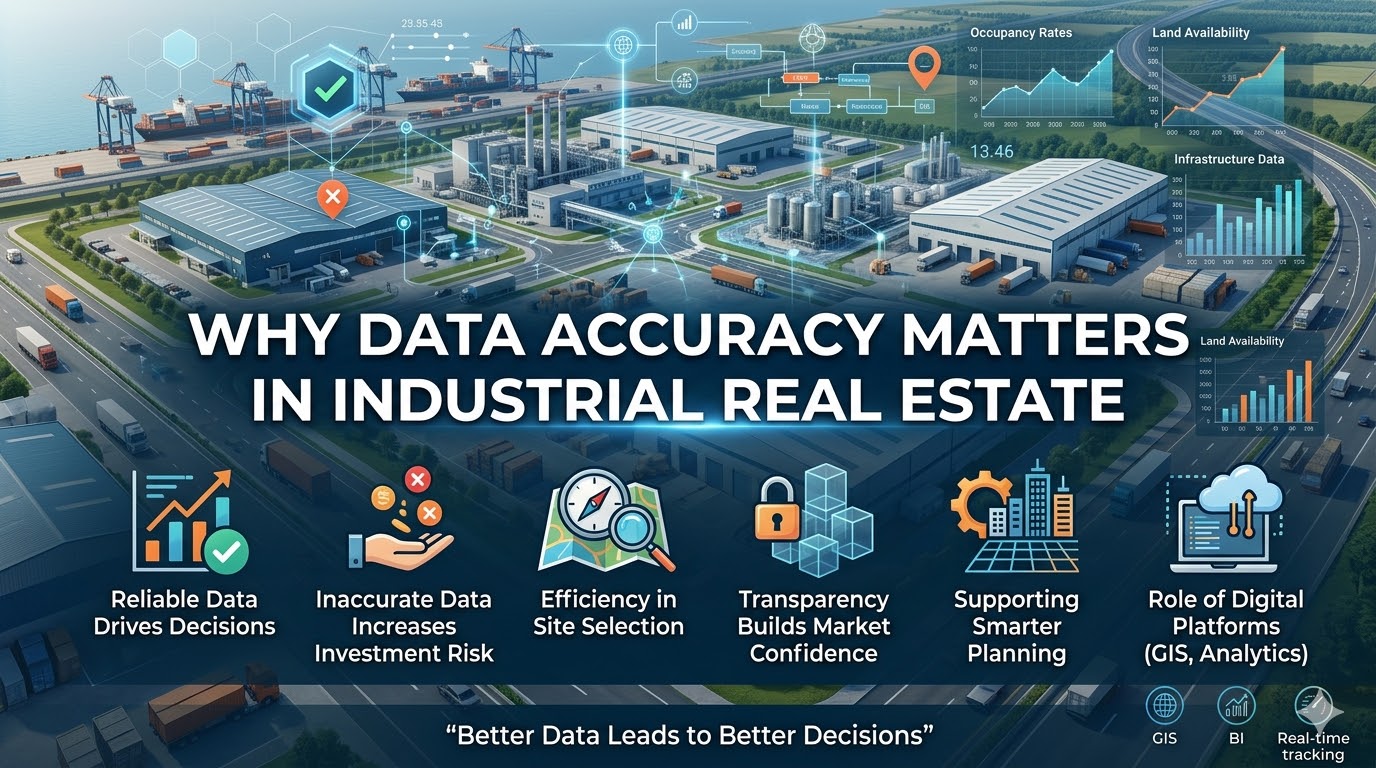
Industrial real estate decisions are fundamentally data-driven decisions. Whether investors are selecting factory locations, developers are planning industrial parks, or governments are allocating industrial land, the accuracy of underlying data determines the quality of those decisions.
In a sector where projects often involve tens or hundreds of millions of dollars in capital investment, inaccurate or outdated data can lead to costly miscalculations. As global manufacturing competition intensifies, the importance of reliable industrial data has become more evident than ever.
1. Industrial Real Estate Decisions Depend on Reliable Data
Unlike residential or commercial real estate, industrial real estate involves complex operational considerations. Investors must evaluate a wide range of variables before committing to a site.
Key data points include:
- Industrial land availability
- Occupancy rates within industrial parks
- Infrastructure connectivity to highways, ports, and airports
- Utility capacity such as electricity, water, and wastewater treatment
- Labor availability in surrounding regions
If any of these datasets are inaccurate, the entire investment analysis can become flawed. A factory built in the wrong location may face logistical bottlenecks, labor shortages, or infrastructure constraints that reduce operational efficiency for years.
2. Inaccurate Data Increases Investment Risk
Manufacturing investment decisions are typically long-term commitments. Once a factory is constructed, relocating operations is extremely difficult and expensive.
When investors rely on inaccurate information—such as overstated land availability or underestimated infrastructure constraints—the consequences can include:
- Delays in project implementation
- Higher logistics costs due to poor connectivity
- Unexpected infrastructure upgrades during construction
- Reduced expansion potential in the future
For multinational manufacturers operating on tight supply chain schedules, these risks can significantly affect global production strategies.
3. Data Accuracy Improves Site Selection Efficiency
Accurate data allows investors to shortlist potential locations faster and more confidently. Instead of spending weeks verifying information across different sources, investors can rely on validated datasets to conduct preliminary analysis quickly.
For example, precise occupancy data enables investors to understand whether an industrial park is nearing full capacity. If a park already has occupancy levels above 90%, expansion opportunities may be limited, prompting investors to explore alternative sites.
By eliminating uncertainty, accurate data significantly shortens the industrial site selection process.
4. Transparency Strengthens Market Confidence
Industrial real estate markets with reliable and transparent data tend to attract more investment. When investors can independently verify information about land availability, infrastructure readiness, and regional development, they perceive lower risk.
Transparent data systems also reduce reliance on informal networks or intermediaries. Investors can analyze opportunities directly using digital platforms and geospatial tools, creating a more efficient and trustworthy investment environment.
Countries that prioritize industrial data transparency often gain a competitive advantage in attracting foreign direct investment.
5. Supporting Smarter Industrial Planning
Accurate industrial data benefits not only investors but also policymakers and developers. Governments can monitor industrial land utilization more effectively and identify regions where infrastructure expansion is required.
Developers can track occupancy patterns and adjust industrial park development strategies accordingly. If certain regions consistently reach high occupancy rates, it signals strong demand for additional industrial zones.
Reliable data therefore enables evidence-based industrial planning, improving the efficiency of land allocation and infrastructure investment.
6. The Role of Digital Platforms in Ensuring Data Accuracy
Advances in digital mapping and industrial intelligence platforms are making it easier to maintain accurate datasets. Technologies such as GIS mapping, real-time occupancy tracking, and centralized industrial databases allow stakeholders to update and verify information continuously.
By integrating data from multiple sources into a single system, these platforms reduce inconsistencies and ensure that investors work with current and validated information.
As industrial ecosystems become more complex, the role of digital data infrastructure will only grow.
7. Building a Data-Driven Industrial Real Estate Market
The future of industrial real estate will increasingly depend on high-quality data ecosystems. Investors, developers, and governments all require accurate information to make informed decisions about land use, infrastructure development, and manufacturing expansion.
In this environment, data accuracy is not merely a technical issue—it is a strategic asset. Markets that maintain reliable industrial data systems will be better positioned to attract investment, optimize land utilization, and support sustainable industrial growth.
Ultimately, the success of industrial real estate markets depends on one simple principle: better data leads to better decisions.
(1).png)