Why Data Beats Brokerage in Industrial Real Estate
Data-driven platforms transform industrial real estate, enabling smarter site selection, minimizing risks, and outperforming traditional brokers in speed, transparency, and ROI.
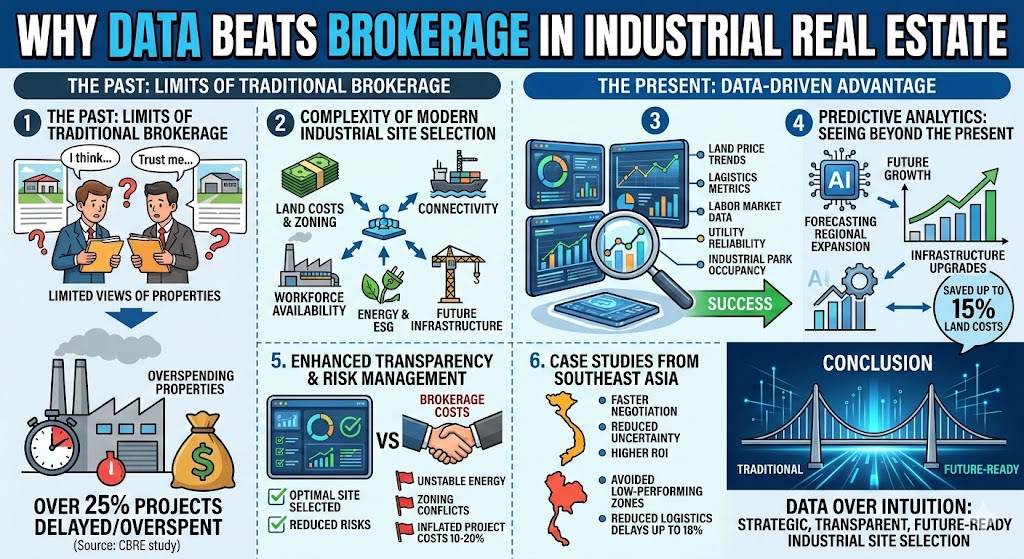
Why Data Beats Brokerage in Industrial Real Estate
1. The Limits of Traditional Brokerage
Historically, industrial real estate relied heavily on brokers. Their expertise, relationships, and local knowledge were invaluable for investors. Yet, this human-centric model has significant limitations. Brokers often operate with limited property visibility, focusing on listings that benefit their network or commissions. This can result in missed opportunities, inflated prices, and suboptimal site choices.
A study by CBRE found that over 25% of industrial projects in Southeast Asia experienced delays or overspending due to incomplete market insights, highlighting the risks of relying solely on personal networks and historical experience.
2. Complexity of Modern Industrial Site Selection
Industrial investment today involves far more variables than before. Investors must consider:
- Land acquisition costs and zoning regulations
- Connectivity to ports, highways, and rail networks
- Workforce availability and skill levels
- Energy reliability and ESG compliance
- Future infrastructure development
Without access to comprehensive datasets, even experienced brokers can overlook these factors. As McKinsey reports, companies that ignore systematic data analysis are 35% more likely to experience operational inefficiencies in new industrial facilities.
3. The Emergence of Data-Driven Platforms
Data-driven platforms consolidate multiple sources of industrial intelligence into one interface. These tools analyze:
- Historical and projected land prices
- Logistics performance metrics
- Labor market trends and wage data
- Utility reliability and environmental risk
- Industrial park occupancy and growth rates
For instance, using such platforms, an investor can compare 20+ industrial parks across Vietnam within minutes, something traditional brokerage would take weeks to research.
4. Predictive Analytics: Seeing Beyond the Present
Unlike brokers, data platforms leverage AI to predict future trends. These systems can forecast:
- Regional industrial expansion
- Port and transport upgrades
- Workforce availability shifts
- Policy changes affecting industrial zoning
A real-world example: a logistics company using predictive analytics identified an upcoming industrial zone near Hai Phong port before it became competitive, saving up to 15% in land costs compared to late entrants.
5. Enhanced Transparency and Risk Management
Data-driven decision-making introduces accountability and clarity. Investors can visualize why a site is optimal or risky. Detailed datasets reduce reliance on anecdotal advice and allow decisions aligned with corporate strategies like sustainability and ESG compliance.
In contrast, brokerage recommendations may hide uncertainties. Without data, investors can unknowingly select sites with hidden costs—like unstable energy supply, insufficient water resources, or zoning conflicts—which can inflate project costs by 10–20%.
6. Case Studies from Southeast Asia
Vietnam: Companies leveraging industrial intelligence platforms can benchmark dozens of industrial parks, comparing connectivity, labor skills, and ESG readiness. The result is faster negotiation, reduced uncertainty, and higher ROI.
Thailand: Investors using data insights avoided low-performing industrial zones, improving operational uptime and reducing logistics delays by up to 18%.
These examples illustrate a clear trend: data-centric strategies outperform brokerage-dependent decisions, especially in rapidly evolving industrial markets.
7. Conclusion
The industrial real estate landscape has entered the age of data-driven investment. While brokers remain relevant for personal networks and negotiation, the competitive edge now belongs to those who leverage comprehensive datasets, AI insights, and predictive analytics. By prioritizing data over intuition, investors reduce risk, maximize returns, and make industrial site selections that are strategic, transparent, and future-ready.
(1).png)