Why Location Intelligence is the New Competitive Edge in FDI.
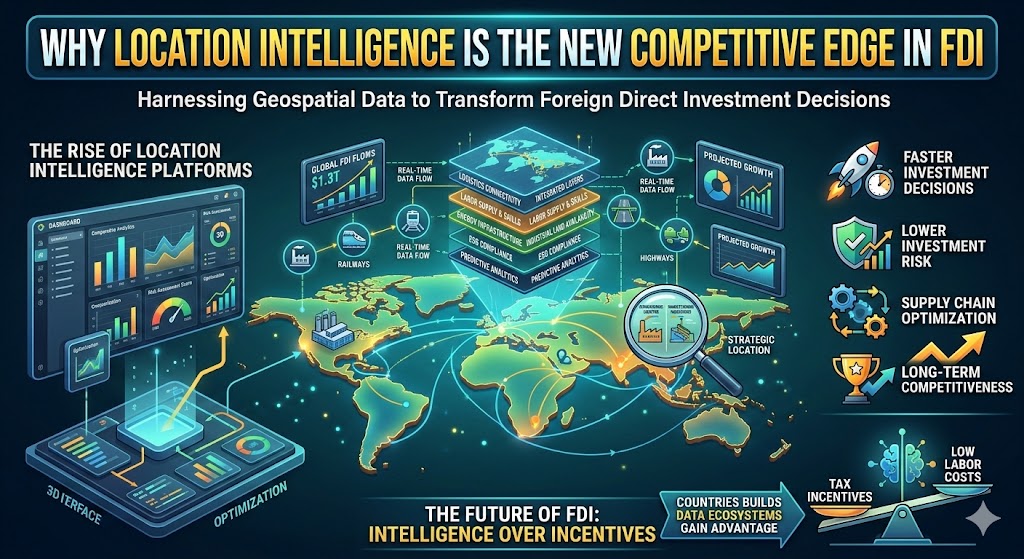
Location intelligence is reshaping FDI decisions. By integrating infrastructure, labor, and industrial data, investors can select optimal factory locations, reduce risks, and gain a strategic edge in global manufacturing.
Why Location Intelligence Is the New Competitive Edge in FDI
1. The Global Competition for Investment Is Intensifying
Foreign Direct Investment (FDI) has become one of the most critical drivers of economic growth, industrial expansion, and job creation worldwide. However, the global investment landscape is becoming increasingly competitive and uncertain.
According to the UNCTAD World Investment Report, global FDI flows reached approximately $1.3 trillion in 2023, despite geopolitical tensions and economic slowdown.
At the same time, the number of international investment projects has declined and competition among countries to attract manufacturing investment has intensified. For investors, the question is no longer simply “where is the cheapest location?”, but rather “where is the most strategic location?”.
This shift has led to the rise of location intelligence—a data-driven approach to selecting factory sites, industrial parks, and logistics hubs.
2. From Guesswork to Data-Driven Location Decisions
For decades, factory location decisions were largely based on broker recommendations, government incentives, or anecdotal market knowledge. While these factors still matter, they are no longer sufficient in a highly interconnected global supply chain.
Manufacturers today must evaluate dozens of variables simultaneously, including:
- Logistics connectivity
- Labor supply and skills
- Energy infrastructure
- Industrial land availability
- ESG compliance requirements
- Long-term regional development trends
Without integrated data, investors risk choosing locations that appear attractive in the short term but create operational inefficiencies later. Location intelligence platforms solve this problem by integrating geospatial data, economic indicators, infrastructure mapping, and predictive analytics into a single decision-making framework.
3. Why Location Matters More Than Ever in Modern Manufacturing
Manufacturing has become deeply dependent on logistics efficiency and supply chain integration.
A factory located just 50–100 kilometers closer to a major port or logistics hub can reduce transportation costs, shorten lead times, and improve supply chain resilience. Over the lifetime of a manufacturing facility, these differences can translate into millions of dollars in operational savings.
Meanwhile, manufacturing investment itself continues to play a major role in global capital flows. Data shows that manufacturing projects remain among the largest categories of FDI worldwide.
This means that countries capable of providing clear location data, infrastructure visibility, and industrial planning transparency gain a strong competitive advantage.
4. The Rise of Location Intelligence Platforms
Location intelligence platforms combine multiple layers of industrial data, including:
- Industrial park distribution and occupancy rates
- Infrastructure networks (ports, highways, railways)
- Workforce availability and demographics
- Energy capacity and utilities
- Environmental and regulatory conditions
Instead of analyzing these factors separately, investors can visualize the entire industrial ecosystem through a unified platform.
5. Southeast Asia and the Data Gap in Industrial Investment
Southeast Asia has become a major destination for global manufacturing relocation as companies diversify supply chains beyond China.
However, one of the region’s biggest challenges remains fragmented industrial data. Information about industrial parks, land availability, infrastructure, and planning is often scattered across different government agencies, brokers, and local authorities.
Without centralized industrial intelligence systems, investors must spend months collecting and verifying information before making location decisions.
Countries that can provide transparent, centralized industrial data platforms are therefore more likely to attract large-scale manufacturing investment.
6. The Strategic Advantage of Location Intelligence
Location intelligence offers several strategic advantages for investors:
1. Faster investment decisions: Investors can analyze hundreds of industrial locations simultaneously rather than relying on manual site visits.
2. Lower investment risk: Integrated data reduces the risk of choosing locations with hidden infrastructure constraints.
3. Supply chain optimization: Factories can be placed strategically near suppliers, logistics hubs, and export gateways.
4. Long-term competitiveness: Investors gain insights into future infrastructure expansion and regional industrial planning.
In an environment where investment competition is intensifying, data transparency and analytical capabilities become strategic assets.
7. The Future of FDI: Intelligence Over Incentives
For many years, countries competed for FDI primarily through tax incentives and low labor costs. While these factors still play a role, the future of investment competition is shifting toward information and infrastructure transparency.
Investors increasingly prefer markets where they can access reliable data about industrial land, logistics networks, workforce distribution, and regulatory conditions.
In this new landscape, location intelligence becomes a national competitive advantage. Countries that build comprehensive industrial data ecosystems will not only attract more investment but also guide it toward the most productive regions.
(1).png)