Why Vietnam Needs a Centralized Industrial Intelligence Platform?
Vietnam’s industrial growth is accelerating, but fragmented data on industrial parks and locations limits investor decisions. A centralized industrial intelligence platform can improve transparency, site selection, and FDI efficiency.
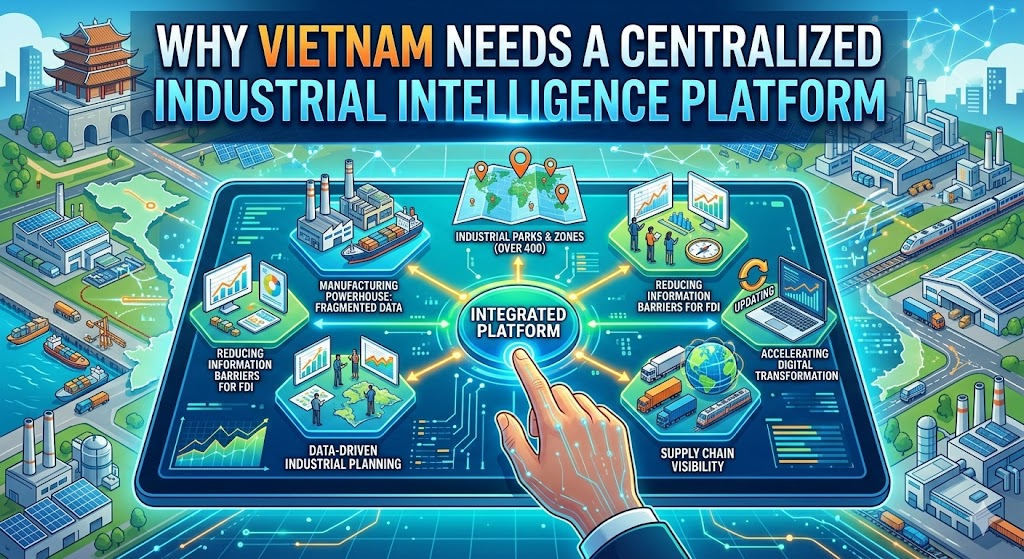
Why Vietnam Needs a Centralized Industrial Intelligence Platform?
1. A Manufacturing Powerhouse Facing Information Fragmentation
Over the past two decades, Vietnam has emerged as one of Asia’s fastest-growing manufacturing hubs. According to the World Bank, the manufacturing sector contributes around 24–25% of Vietnam’s GDP, a remarkably high share compared with many economies at similar income levels. At the same time, foreign direct investment continues to flow strongly into industrial production.
Data from the Ministry of Planning and Investment of Vietnam shows that FDI disbursement exceeded $23 billion in 2023, with most capital directed toward manufacturing industries such as electronics, machinery, and consumer goods.
Despite this impressive growth, one structural challenge remains: industrial information in Vietnam is still highly fragmented. Investors often struggle to access reliable, standardized data about industrial parks, infrastructure conditions, labor availability, or logistics networks. This fragmentation slows investment decisions and increases uncertainty for both domestic and international manufacturers.
2. The Rapid Expansion of Industrial Parks
Vietnam’s industrial landscape has expanded rapidly in recent years. According to official data from the Vietnam Ministry of Planning and Investment, the country currently has more than 400 industrial parks and economic zones, covering tens of thousands of hectares across the country.
These zones play a crucial role in attracting manufacturing investment. In many provinces, industrial parks account for a large share of export production and job creation.
However, information about these industrial zones is often scattered across multiple provincial portals, investment promotion agencies, and private real estate developers. Investors must spend significant time collecting and verifying data before they can even begin comparing potential locations.
A centralized industrial intelligence platform could solve this problem by bringing together reliable information into a single, accessible system.
3. Reducing Information Barriers for Foreign Investors
Foreign investors evaluating manufacturing locations typically compare multiple countries before making a decision. Factors such as infrastructure readiness, logistics connectivity, labor availability, and regulatory procedures all influence the final choice.
Countries that provide transparent and easily accessible industrial data often gain a competitive advantage. According to the United Nations Conference on Trade and Development, clear investment information and digital investment platforms can significantly shorten the decision-making cycle for foreign investors.
Without a centralized data system, Vietnam risks losing potential investment simply because investors cannot quickly obtain the information they need.
An industrial intelligence platform would allow manufacturers to evaluate industrial parks, compare infrastructure conditions, and analyze logistics networks more efficiently.
4. Supporting Data-Driven Industrial Planning
A centralized industrial intelligence platform would also benefit policymakers and regional planners. Industrial development is not only about attracting investment; it also requires coordinated planning across infrastructure, workforce development, and logistics networks.
When industrial data is fragmented, it becomes difficult for policymakers to understand the full picture of national industrial capacity.
By integrating data such as:
- Industrial land availability
- Transportation infrastructure
- Labor market statistics
- Supply chain networks
- A centralized platform could provide decision-makers with deeper insights into how industrial development is evolving across different regions.
This kind of data-driven planning helps ensure that infrastructure investment aligns with industrial growth.
5. Strengthening Supply Chain Visibility
Modern manufacturing depends on highly interconnected supply chains. Companies rarely operate in isolation; they rely on networks of suppliers, logistics providers, and supporting industries.
According to research by McKinsey & Company, companies with strong supply chain visibility can reduce logistics costs by up to 15–20% and respond more effectively to disruptions.
A centralized industrial intelligence platform could map supplier networks, logistics corridors, and manufacturing clusters across Vietnam. This visibility would help investors identify locations where supply chains are already well developed.
Such insights are particularly important for industries like electronics, automotive components, and precision manufacturing.
6. Accelerating Digital Transformation in Industrial Development
Vietnam is actively promoting digital transformation across multiple sectors of the economy. Industrial development should be part of this broader transition.
Digital industrial intelligence platforms combine geospatial data, economic indicators, and infrastructure information into interactive systems that support real-time analysis. Investors can evaluate potential locations, simulate logistics routes, and analyze workforce availability within a single digital environment.
Many advanced economies already use such systems to support industrial planning and investment promotion. By developing a centralized platform, Vietnam could significantly modernize the way industrial information is managed and shared.
7. Building a Smarter Industrial Ecosystem
As global manufacturing becomes more competitive and data-driven, access to reliable information will become increasingly important. Industrial intelligence platforms are not merely databases—they are strategic tools that shape investment flows, infrastructure planning, and supply chain development.
For Vietnam, building a centralized industrial intelligence platform could strengthen its position as a global manufacturing destination. By improving transparency, supporting data-driven planning, and simplifying investment decisions, such a system would help create a more efficient and competitive industrial ecosystem.
In the long run, the countries that manage industrial information most effectively will also be the ones that attract the most dynamic manufacturing investment.
(1).png)